The amazing Technicolor dreamworld of Oz, as originally imagined at the turn of the 20th century by children’s author L. Frank Baum, was unforgettably brought to life in the iconic 1939 screen musical “The Wizard of Oz,” a groundbreaking masterwork that would enrich and live on in childhood memories for decades to come — just think of the glimmering green towers of the Emerald City or the swirling golden spiral that births the Yellow Brick Road, and feel that flood of sweet nostalgia wash over you and cleanse your soul. Seven decades later, we return to director Victor Fleming’s fantasy wonderland in “Oz the Great and Powerful,” Disney’s spiritual prequel to the MGM classic, which — copyright issues kept in mind — rebuilds the land brick by yellow brick, albeit with more than a little help from computerised jiggery-pokery.
Of course, this is not the first time Oz has been paid a grand revisit by Hollywood — 1978’s “The Wiz" retold Dorothy Gale's tale with a Harlem-inspired urban environment, while 1985’s “Return to Oz" continued her adventures with a dark and twisted steampunk edge — but not since the Golden Age has it been so richly detailed, elaborately designed and vividly realised. Director Sam Raimi, whose blockbusting “Spider-Man” trilogy was a technical marvel, seamlessly blends practical sets with computer-generated imagery and presents Oz in carefully orchestrated 3D that bursts out from the screen — here, Oz is as immersive as the alien moon Pandora in James Cameron’s “Avatar.”
Journeying with us through this magical realm is James Franco (“127 Hours”) as Oscar “Oz" Diggs, the one destined to become the “man behind the curtain.” Oscar is an ambitious, small-time carnival magician and charlatan who, in 1905, is whisked away from humble Kansas to the magnificent Land of Oz when his hot air balloon is consumed by a vicious cyclone — this is achieved in a dazzling sequence during which the film makes a startling transition from Academy-ratio monochrome to widescreen Technicolor, surely an affectionate homage to Oz’s wondrous introduction in Fleming’s original. Upon arrival, Oscar discovers he is prophesied to free the locals from the tyrannical Wicked Witch of the West and become the rightful ruler of Oz, a task he reluctantly takes on in the name of fame and fortune.
Joining him on his perilous quest is Finley (voiced by Zach Braff, “Scrubs”), a winged, scene-stealing chimp in a bellhop’s outfit, and an adorable two-foot girl made of china (voiced by Joey King, “Ramona and Beezus”), whose shattered legs are repaired by Oscar in a touching scene following an attack on her porcelain village. Both Braff and King appear physically as human characters in the Kansas-set prologue, just like the Scarecrow, Tin Man and Cowardly Lion in Fleming’s film, but with slightly less impact: the intended effect isn’t quite the same when actors reappearing from real-world Kansas are merely providing voices for their characters in Oz.
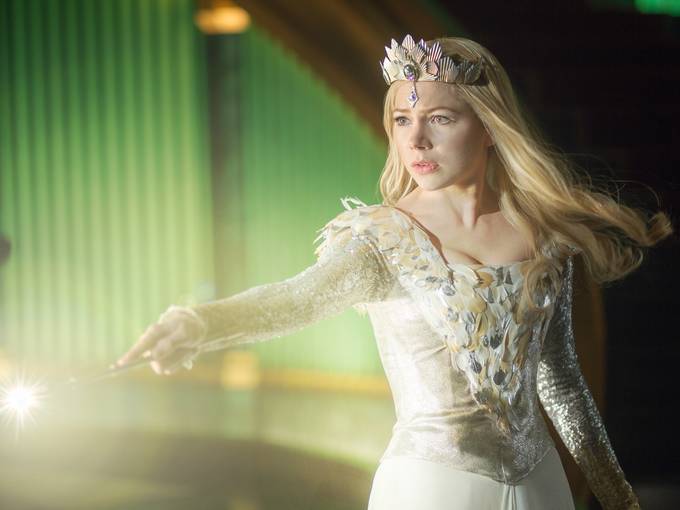
As in Shakespeare’s “Macbeth," there are three witches in this origin story. Michelle Williams (“My Week with Marilyn”), a stand-out, is bubbly and wise as Glinda the Good Witch; Rachel Weisz (“The Bourne Legacy") is deliciously menacing as the ruthless and conniving but ever so elegant Evanora; while Mila Kunis (“Black Swan”) gets the film’s meatiest role as the naive and easily manipulated Theodora, whose tragic descent into the dark side (or should that be the green side?) is a little unconvincing; though Kunis plays both sides of Theodora marvelously, the set-up of her character’s physical and psychological transformation is far too rushed, the end result failing to pack the necessary punch.
As for our fated wizard, though Franco grants him a roguish grin and a rascally charm, one can’t help but feel the fizzily charismatic Robert Downey, Jr. — an early candidate for the role — would have been better suited in Oscar's top hat and waistcoat. The real star of the show is the infectiously enthusiastic Raimi, whose kooky visual quirks are on full display throughout and whose horror roots are showing: remembering the fear struck into the hearts of many a movie-goer by those barbaric flying monkeys in 1939, he here uses the winged beasts for one or two inspired frights — after all, what’s a trip to the movies without a good scare?
What’s most remarkable about “Oz the Great and Powerful” is the degree to which Raimi has provided for audiences of all ages; here is a family movie truly suitable for all the family, capable of entertaining the young and the old in equal measure. Considering its unblinking commitment to breathtaking spectacle and its luscious, vibrantly rendered fairy tale setting, comparisons to Tim Burton’s crushingly disappointing “Alice in Wonderland” are unavoidable, and Raimi’s film thankfully comes out on top: for behind all its whiz-bang special effects and sensational production design is something Burton’s dead-eyed dud was crucially missing, a key ingredient that keeps us engaged and enchanted right from its black-and-white beginnings all the way through to its explosive finale — a healthy heart beating away inside its chest.
7/10
Showing posts with label adventure. Show all posts
Monday, 11 March 2013
Monday, 11 February 2013
Wreck-It Ralph
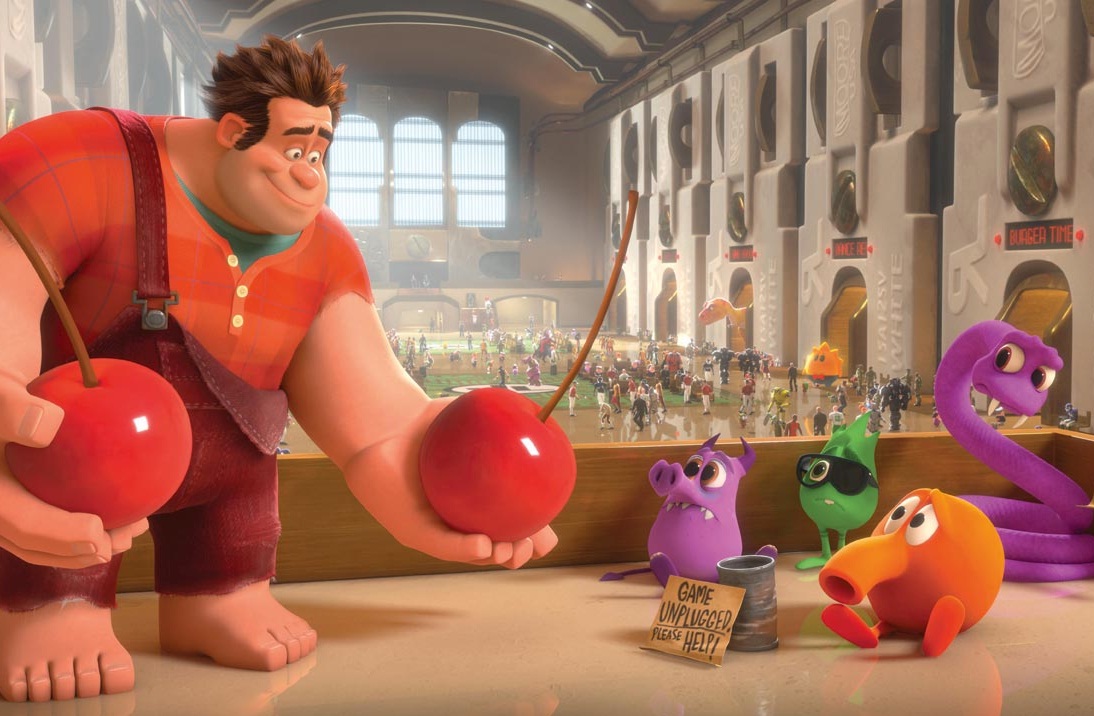
Life is tough for Wreck-It Ralph, the bad-tempered villain of an 8-bit arcade game. It is a life lived within the various coin-operated machines of Litwak’s Arcade, but mostly within 30-year-old popular platformer “Fix-It Felix, Jr.,” where Ralph is a sort of humanised Donkey Kong figure; a gentle giant, he stands at a mighty 9 ft, weighs an elephantine 643 pounds and is gifted with tractor-sized fists that can demolish all that they touch. His job — if you can call it that — sees him scaling and angrily pounding at the outside of a high-rise building with his bare hands, a quest of wanton destruction instantly undone by the player’s avatar, celebrated goody-two-shoes and magically tooled handyman Fix-It Felix, Jr (Jack McBrayer, “30 Rock”).
When the day is done, i.e. when Litwak’s Arcade shuts down for the night, Ralph retreats to a junkyard and sleeps in amongst a pile of bricks, dreaming of a life where he is beloved and where he is a hero — badguys rarely get the credit they deserve for their hard work and effort. This is a life spectacularly realised in “Wreck-It Ralph,” a delightfully playful and wildly imaginative Walt Disney computer-animation in which video game characters enjoy a life of their own when free from the control of their human players. They share this quality with the plastic playthings of Disney/Pixar’s “Toy Story,” if lacking the universally felt magic of that film’s concept: we have all at one point imagined that our inanimate toys spring to life when our backs are turned, but have we ever thought the same of a video game character?
Still, what “Wreck-It Ralph” has by the truckload is an infectious fondness for its pixelated protagonists and dollops of sweet nostalgia that will transform any casual gamer of the 1980s into as giddy a seven-year-old as the ones sitting in the audience with them: thanks to the dazzling array of brain-implanted video game sound effects and backdrops that are on frequent display, childhood memories of frantic button-pushing and joystick-manoeuvring will come flooding back with the unstoppable thrust and overwhelming force of a full-scale tsunami. And I haven’t even mentioned the countless familiar faces to be recognised throughout: the likes of Sonic the Hedgehog and Q*bert can be seen wandering through Game Central Station, while in a Badguys Anonymous support group, Ralph discusses his problems with M. Bison from “Street Fighter," Bowser from “Super Mario Bros.” and one of the ghosts from that old-school classic, “Pac-Man.”
Wreck-It Ralph himself, however, is an original creation, even if Disney have been so kind and thoughtful as to have made a real-life “Fix-It Felix, Jr.” game available for playing online — I’ve played it myself, and, like the film, it’s a good deal of fun. He is voiced by John C. Reilly (“Step Brothers”), usually a supporting actor whose endearing, sad-sack voice is a vital cog in Ralph’s lovability; here is a good-natured character who wishes to be appreciated, who watches with jealousy as Fix-It Felix receives praise for his work while he remains unrecognised and is faced with rejection upon pursuit of it.
It is a jealousy that causes him to abandon his game in search of popularity, a move referred to by fellow game characters as “going Turbo,” a reference to a racing character who, in a bid for attention, broke into the arcade’s newest racing game and consequently had his own game unplugged. Ralph’s journey sees him integrated into other games, and one of the many joys of “Wreck-It Ralph" is its gorgeously designed, meticulously detailed world-building: Ralph first encounters the very modern “Hero’s Duty,” a high-def first-person shooter that is essentially a sci-fi-twisted “Call of Duty” in which heavily armed marines do battle with giant, flying space bugs. “When did video games get so violent and scary?" Ralph wimpishly remarks upon entry.
But most of the action takes place in “Sugar Rush,” a teeny-bopper go-kart racing game made unique by the fact that it is made entirely out of colourful confectionery: its sugar-coated sites include a forest of candy cane trees and a river of chocolate, while, in a neat touch, the two local police officers are a pair of walking, talking donuts. Such a world provides ample opportunity for shameless product placement, and sadly, “Wreck-It Ralph” gives into such distracting, corporate-driven urges: our hero falls victim to Nesquik sand and encounters a Diet Cola volcano made eruptive by falling Mentos. This jars with the film’s intentions to lovingly pay tribute to the world of video games, and one might feel a slight tingle of cynicism when such moments pop up.
This is, however, vanquished whenever the adorably sprightly and lovably bratty Vanellope von Schweetz (Sarah Silverman with a lungful of helium) is on-screen, which is thankfully often. She’s a smart-mouthed young resident of “Sugar Rush” whose dream is to be a go-kart racer; this, in spite of the fact that she is a “glitch,” and that it is strictly forbidden for glitches to race in “Sugar Rush.” Ralph quickly befriends Miss von Schweetz, and promises to help her achieve her goal; King Candy (Alan Tudyk, “Firefly”), the lisping ruler of “Sugar Rush,” has other, more diabolical plans for this malfunctioning tot.
Meanwhile, in an enjoyable sub-plot, Ralph is chased by Calhoun (Jane Lynch, “Glee"), the hard-ass sergeant from “Hero's Duty" supposedly programmed with “the most tragic back-story ever" — her beloved fiancé was gobbled up by a wedding-crashing space bug, one of which Ralph may have inadvertently set loose inside “Sugar Rush." Felix enthusiastically tags along, fearing that his game will be shut down forever if Ralph does not return in time. This leads to a climax that is disappointingly generic in its action-packed mayhem, but which is saved by its characters — it helps a great deal that we have been given time to watch them grow and learn to care about them.
I have a suggestion for the sequel, which, given the film’s box office figures, looks likely. All of the action in “Wreck-It Ralph" takes place inside Litwak’s Arcade and the games contained therein. But what if Ralph and his friends were to venture outside of the arcade and encounter multiple versions of themselves in other arcades — what if Ralph were to interact with another Wreck-It Ralph, like Buzz and the whole supermarket aisle of new-and-improved Buzz Lightyears in “Toy Story 2?" Anyway, it’s just a suggestion. I have a feeling that “Wreck-It Ralph,” like so many family films, will be played on a never-ending loop in households throughout the world when it is released on home video — it will, however, have the rare luxury of being repeatedly placed into the DVD player not just by children but by thirty-something gamers too.
7/10
When the day is done, i.e. when Litwak’s Arcade shuts down for the night, Ralph retreats to a junkyard and sleeps in amongst a pile of bricks, dreaming of a life where he is beloved and where he is a hero — badguys rarely get the credit they deserve for their hard work and effort. This is a life spectacularly realised in “Wreck-It Ralph,” a delightfully playful and wildly imaginative Walt Disney computer-animation in which video game characters enjoy a life of their own when free from the control of their human players. They share this quality with the plastic playthings of Disney/Pixar’s “Toy Story,” if lacking the universally felt magic of that film’s concept: we have all at one point imagined that our inanimate toys spring to life when our backs are turned, but have we ever thought the same of a video game character?
Still, what “Wreck-It Ralph” has by the truckload is an infectious fondness for its pixelated protagonists and dollops of sweet nostalgia that will transform any casual gamer of the 1980s into as giddy a seven-year-old as the ones sitting in the audience with them: thanks to the dazzling array of brain-implanted video game sound effects and backdrops that are on frequent display, childhood memories of frantic button-pushing and joystick-manoeuvring will come flooding back with the unstoppable thrust and overwhelming force of a full-scale tsunami. And I haven’t even mentioned the countless familiar faces to be recognised throughout: the likes of Sonic the Hedgehog and Q*bert can be seen wandering through Game Central Station, while in a Badguys Anonymous support group, Ralph discusses his problems with M. Bison from “Street Fighter," Bowser from “Super Mario Bros.” and one of the ghosts from that old-school classic, “Pac-Man.”
Wreck-It Ralph himself, however, is an original creation, even if Disney have been so kind and thoughtful as to have made a real-life “Fix-It Felix, Jr.” game available for playing online — I’ve played it myself, and, like the film, it’s a good deal of fun. He is voiced by John C. Reilly (“Step Brothers”), usually a supporting actor whose endearing, sad-sack voice is a vital cog in Ralph’s lovability; here is a good-natured character who wishes to be appreciated, who watches with jealousy as Fix-It Felix receives praise for his work while he remains unrecognised and is faced with rejection upon pursuit of it.
It is a jealousy that causes him to abandon his game in search of popularity, a move referred to by fellow game characters as “going Turbo,” a reference to a racing character who, in a bid for attention, broke into the arcade’s newest racing game and consequently had his own game unplugged. Ralph’s journey sees him integrated into other games, and one of the many joys of “Wreck-It Ralph" is its gorgeously designed, meticulously detailed world-building: Ralph first encounters the very modern “Hero’s Duty,” a high-def first-person shooter that is essentially a sci-fi-twisted “Call of Duty” in which heavily armed marines do battle with giant, flying space bugs. “When did video games get so violent and scary?" Ralph wimpishly remarks upon entry.
But most of the action takes place in “Sugar Rush,” a teeny-bopper go-kart racing game made unique by the fact that it is made entirely out of colourful confectionery: its sugar-coated sites include a forest of candy cane trees and a river of chocolate, while, in a neat touch, the two local police officers are a pair of walking, talking donuts. Such a world provides ample opportunity for shameless product placement, and sadly, “Wreck-It Ralph” gives into such distracting, corporate-driven urges: our hero falls victim to Nesquik sand and encounters a Diet Cola volcano made eruptive by falling Mentos. This jars with the film’s intentions to lovingly pay tribute to the world of video games, and one might feel a slight tingle of cynicism when such moments pop up.
This is, however, vanquished whenever the adorably sprightly and lovably bratty Vanellope von Schweetz (Sarah Silverman with a lungful of helium) is on-screen, which is thankfully often. She’s a smart-mouthed young resident of “Sugar Rush” whose dream is to be a go-kart racer; this, in spite of the fact that she is a “glitch,” and that it is strictly forbidden for glitches to race in “Sugar Rush.” Ralph quickly befriends Miss von Schweetz, and promises to help her achieve her goal; King Candy (Alan Tudyk, “Firefly”), the lisping ruler of “Sugar Rush,” has other, more diabolical plans for this malfunctioning tot.
Meanwhile, in an enjoyable sub-plot, Ralph is chased by Calhoun (Jane Lynch, “Glee"), the hard-ass sergeant from “Hero's Duty" supposedly programmed with “the most tragic back-story ever" — her beloved fiancé was gobbled up by a wedding-crashing space bug, one of which Ralph may have inadvertently set loose inside “Sugar Rush." Felix enthusiastically tags along, fearing that his game will be shut down forever if Ralph does not return in time. This leads to a climax that is disappointingly generic in its action-packed mayhem, but which is saved by its characters — it helps a great deal that we have been given time to watch them grow and learn to care about them.
I have a suggestion for the sequel, which, given the film’s box office figures, looks likely. All of the action in “Wreck-It Ralph" takes place inside Litwak’s Arcade and the games contained therein. But what if Ralph and his friends were to venture outside of the arcade and encounter multiple versions of themselves in other arcades — what if Ralph were to interact with another Wreck-It Ralph, like Buzz and the whole supermarket aisle of new-and-improved Buzz Lightyears in “Toy Story 2?" Anyway, it’s just a suggestion. I have a feeling that “Wreck-It Ralph,” like so many family films, will be played on a never-ending loop in households throughout the world when it is released on home video — it will, however, have the rare luxury of being repeatedly placed into the DVD player not just by children but by thirty-something gamers too.
7/10
Tuesday, 18 December 2012
The Hobbit: An Unexpected Journey
The problem with “The Hobbit: An Unexpected Journey” — and it’s a problem many fans have likely foreseen — is that it follows in the Middle-earth-shattering footsteps of a giant. Peter Jackson’s masterfully assembled “Lord of the Rings” films, based on J. R. R. Tolkien’s classic fantasy book series, arguably made for the greatest trilogy to have ever graced the silver screen: staggeringly epic, meticulous in its world-building, showered in Academy Awards and instantly amassing a legion of hardcore enthusiasts, it was a crowning achievement that, for some, was the true “Star Wars” of the noughties. By sheer comparison, this first entry in a three-part adaptation of Tolkien’s more kiddy-friendly “The Hobbit,” while boasting its own thrills and charms, comes up a little short — it’s a hobbit pitted against a giant it couldn’t possibly outmatch.
It’s a comparison that might have been uncalled for if it weren’t for the direct connections Jackson makes between this new prequel trilogy and the earlier films: a wholly unnecessary prologue finds Ian Holm’s Bilbo Baggins and Elijah Wood’s Frodo having a chat in the former’s humble home, while Cate Blanchett, Hugo Weaving and Christopher Lee briefly return in a visit to the opulent Elven outpost Rivendell. Even some of the musical cues are the same: the re-introduction of the Shire is soundtracked by Howard Shore’s whimsical piece “Concerning Hobbits,” and the appearance of the one true “precious” ring is greeted with that ominous string melody from “The Prophecy.”
Indeed, the “Hobbit" series looks set to wander down the same route traversed by “The Lord of the Rings,” regardless of whether or not it is fit for such a lengthy trek: what we are getting once again is a trio of closely released three-hour epics covering a perilous on-foot adventure across the treacherous mountains and thorny forests of the orc-infested Middle-earth (here 60 years younger). What we’re not getting is as compelling a story: in “The Lord of the Rings,” the Fellowship’s quest was necessary in stopping the evil Sauron from gaining ultimate power and turning the land into a post-apocalyptic wasteland; in “The Hobbit,” the quest embarked on by our heroes is merely to reclaim a dwarf kingdom from a pillaging dragon that snoozes in amongst its piles of golden treasures.
Still, while the destination isn’t as pressing this time round, this unexpected journey is always enjoyable, and our travelers make for good company. Our unlikely, 3ft-tall hero is Bilbo Baggins, as played by the always appealing Martin Freeman (“Sherlock”). A pipe-smoking, pointy-eared, hairy-footed resident of the sunnily picturesque village of Hobbiton, the timid Bilbo lives a snug but largely uneventful life that is one day disturbed by wise wizard Gandalf the Grey (Ian McKellen, “X-Men”). Gandalf seeks Bilbo’s help: he requires a burglar to sneak into the Lonely Mountain with him and steal the treasure from the villainous dragon Smaug (that’s pronounced “smowg,” not “smog”), and the pint-sized Bilbo seems an ideal candidate.
Reluctantly, Bilbo agrees to be Gandalf’s burglar, finally venturing out from the comfort of his home to embark on an adventure that may well claim his life. Accompanying them is a band of thirteen warrior dwarves cruelly driven out of Erebor kingdom by Smaug. Flaunting ferocious appetites, bellowing singing voices and boundless energy, these diminutive goofballs are a hairy-faced delight, although differentiating between a few of them proves a difficult task. Leader of the pack is the brooding Thorin Oakenshield (Richard Armitage, “Spooks”), essentially Aragorn but half the stature. As their quest begins, Thorin is ruthlessly hunted by the vengeful pale orc Azog, whose right forearm was lopped off by Thorin’s blade mid-battle.
Their journey, like that of the Fellowship, brings them to sensational set-pieces. In the woods one night they encounter a trio of lumbering, horse-thieving Cockney trolls who develop a taste for dwarf and hobbit. On a mountainside they find themselves in the midst of a tussle between towering giants made of stone, dodging chunks of the mountain hurled by both opponents. In the film’s most bombastic sequence, they escape from an underground cave system, chased by an army of goblins across rickety wooden bridges atop bottomless gorges. Jackson maintains his rousing visual flair in framing these sequences, lending the action an epic scope and a sweeping pizzazz.
But where “The Hobbit” shines brightest is when Gollum, that bug-eyed ex-hobbit, crawls out from the darkness of his cave to engage in a game of riddles with Bilbo. It’s a tense scene, the most suspenseful in the film, as our intrepid little hero takes part in a battle of wits against an instinctively deceptive, clinically schizophrenic creature of the dark. The great Andy Serkis, again voicing the iconic character and providing his every spidery movement, damn near steals the show, and, as stunningly rendered with state-of-the-art special effects, Gollum has never looked so good (well, considering...).
Trouble is, many of these set-pieces feel like needless diversions from the central quest, especially in that aforementioned visit to Rivendell (found nowhere in Tolkien’s book). One senses that Jackson and co-writers Fran Walsh, Phillipa Boyens and Guillermo del Toro are overstretching Tolkien’s original text for the sake of shaping it into the soaring “Lord of the Rings" mould (after 169 minutes, we’ve reached the beginning of chapter seven). Speaking of which, there’s a dilemma at the film’s core: does Jackson want this to be the lighthearted, rompish “The Hobbit” of Tolkien’s story, and thus grant the film its own identity, or does he want to stick to the grim, gritty violence of “The Lord of the Rings”? The Kiwi director, I’m afraid, fails to make a decision, resulting in slapstick shenanigans and graphic beheadings occurring within mere seconds of each other (and, as in one poor goblin’s delayed decapitation, at the exact same time).
What holds it all together, the magnificent production values and Jackson’s eye for stunning spectacle aside, is Freeman. The British actor’s good-natured charm and uncanny knack for deadpan comic delivery make for a brilliant Bilbo Baggins whose growing courage and lion-hearted heroism is completely convincing. Like Frodo, Sam, Merry and Pippin from the previous films, Bilbo is hopelessly out of place in a band of experienced warriors on a trek to save the day, but we as an audience are with him all the way. A key question in Tolkien’s original book is why Bilbo decides to join Gandalf and the dwarves on their dauntless expedition. His reason is the same as ours: for the adventure.
Endnote: I saw “The Hobbit: An Unexpected Journey” in 3-D and in 48 frames per second. The 3-D is immersive and not a distraction. The same cannot be said for 48 fps: while it undeniably gives the image a crisp, crystal clarity, it also makes the film look like a televised (dare I say cheap) BBC production, while the often unnaturally speedy movements of the characters and the camera give the impression that the film is stuck on fast-forward (think Benny Hill being chased by nurses). My advice: see it in the standard 24 fps first time round to bask in the story and characters undisturbed and, if curious about the higher frame-rate, see it in 48 fps the second time round.
7/10
It’s a comparison that might have been uncalled for if it weren’t for the direct connections Jackson makes between this new prequel trilogy and the earlier films: a wholly unnecessary prologue finds Ian Holm’s Bilbo Baggins and Elijah Wood’s Frodo having a chat in the former’s humble home, while Cate Blanchett, Hugo Weaving and Christopher Lee briefly return in a visit to the opulent Elven outpost Rivendell. Even some of the musical cues are the same: the re-introduction of the Shire is soundtracked by Howard Shore’s whimsical piece “Concerning Hobbits,” and the appearance of the one true “precious” ring is greeted with that ominous string melody from “The Prophecy.”
Indeed, the “Hobbit" series looks set to wander down the same route traversed by “The Lord of the Rings,” regardless of whether or not it is fit for such a lengthy trek: what we are getting once again is a trio of closely released three-hour epics covering a perilous on-foot adventure across the treacherous mountains and thorny forests of the orc-infested Middle-earth (here 60 years younger). What we’re not getting is as compelling a story: in “The Lord of the Rings,” the Fellowship’s quest was necessary in stopping the evil Sauron from gaining ultimate power and turning the land into a post-apocalyptic wasteland; in “The Hobbit,” the quest embarked on by our heroes is merely to reclaim a dwarf kingdom from a pillaging dragon that snoozes in amongst its piles of golden treasures.
Still, while the destination isn’t as pressing this time round, this unexpected journey is always enjoyable, and our travelers make for good company. Our unlikely, 3ft-tall hero is Bilbo Baggins, as played by the always appealing Martin Freeman (“Sherlock”). A pipe-smoking, pointy-eared, hairy-footed resident of the sunnily picturesque village of Hobbiton, the timid Bilbo lives a snug but largely uneventful life that is one day disturbed by wise wizard Gandalf the Grey (Ian McKellen, “X-Men”). Gandalf seeks Bilbo’s help: he requires a burglar to sneak into the Lonely Mountain with him and steal the treasure from the villainous dragon Smaug (that’s pronounced “smowg,” not “smog”), and the pint-sized Bilbo seems an ideal candidate.
Reluctantly, Bilbo agrees to be Gandalf’s burglar, finally venturing out from the comfort of his home to embark on an adventure that may well claim his life. Accompanying them is a band of thirteen warrior dwarves cruelly driven out of Erebor kingdom by Smaug. Flaunting ferocious appetites, bellowing singing voices and boundless energy, these diminutive goofballs are a hairy-faced delight, although differentiating between a few of them proves a difficult task. Leader of the pack is the brooding Thorin Oakenshield (Richard Armitage, “Spooks”), essentially Aragorn but half the stature. As their quest begins, Thorin is ruthlessly hunted by the vengeful pale orc Azog, whose right forearm was lopped off by Thorin’s blade mid-battle.
Their journey, like that of the Fellowship, brings them to sensational set-pieces. In the woods one night they encounter a trio of lumbering, horse-thieving Cockney trolls who develop a taste for dwarf and hobbit. On a mountainside they find themselves in the midst of a tussle between towering giants made of stone, dodging chunks of the mountain hurled by both opponents. In the film’s most bombastic sequence, they escape from an underground cave system, chased by an army of goblins across rickety wooden bridges atop bottomless gorges. Jackson maintains his rousing visual flair in framing these sequences, lending the action an epic scope and a sweeping pizzazz.
But where “The Hobbit” shines brightest is when Gollum, that bug-eyed ex-hobbit, crawls out from the darkness of his cave to engage in a game of riddles with Bilbo. It’s a tense scene, the most suspenseful in the film, as our intrepid little hero takes part in a battle of wits against an instinctively deceptive, clinically schizophrenic creature of the dark. The great Andy Serkis, again voicing the iconic character and providing his every spidery movement, damn near steals the show, and, as stunningly rendered with state-of-the-art special effects, Gollum has never looked so good (well, considering...).
Trouble is, many of these set-pieces feel like needless diversions from the central quest, especially in that aforementioned visit to Rivendell (found nowhere in Tolkien’s book). One senses that Jackson and co-writers Fran Walsh, Phillipa Boyens and Guillermo del Toro are overstretching Tolkien’s original text for the sake of shaping it into the soaring “Lord of the Rings" mould (after 169 minutes, we’ve reached the beginning of chapter seven). Speaking of which, there’s a dilemma at the film’s core: does Jackson want this to be the lighthearted, rompish “The Hobbit” of Tolkien’s story, and thus grant the film its own identity, or does he want to stick to the grim, gritty violence of “The Lord of the Rings”? The Kiwi director, I’m afraid, fails to make a decision, resulting in slapstick shenanigans and graphic beheadings occurring within mere seconds of each other (and, as in one poor goblin’s delayed decapitation, at the exact same time).
What holds it all together, the magnificent production values and Jackson’s eye for stunning spectacle aside, is Freeman. The British actor’s good-natured charm and uncanny knack for deadpan comic delivery make for a brilliant Bilbo Baggins whose growing courage and lion-hearted heroism is completely convincing. Like Frodo, Sam, Merry and Pippin from the previous films, Bilbo is hopelessly out of place in a band of experienced warriors on a trek to save the day, but we as an audience are with him all the way. A key question in Tolkien’s original book is why Bilbo decides to join Gandalf and the dwarves on their dauntless expedition. His reason is the same as ours: for the adventure.
Endnote: I saw “The Hobbit: An Unexpected Journey” in 3-D and in 48 frames per second. The 3-D is immersive and not a distraction. The same cannot be said for 48 fps: while it undeniably gives the image a crisp, crystal clarity, it also makes the film look like a televised (dare I say cheap) BBC production, while the often unnaturally speedy movements of the characters and the camera give the impression that the film is stuck on fast-forward (think Benny Hill being chased by nurses). My advice: see it in the standard 24 fps first time round to bask in the story and characters undisturbed and, if curious about the higher frame-rate, see it in 48 fps the second time round.
7/10
Saturday, 15 December 2012
Rise of the Guardians
Despite the confusing connection between their vaguely heroic titles, “Rise of the Guardians” is not a sequel — nor, for that matter, a prequel — to Zack Snyder’s straight-faced 2010 computer-animation “Legend of the Guardians: The Owls of Ga’Hoole." Rather, it is a DreamWorks-produced, CGI-rendered adaptation of William Joyce’s bestselling children’s series “The Guardians of Childhood,” in which the eponymous protectors are much more festive and much less feathery: standing side by side are timeless fairy tale figures Santa Claus, the Easter Bunny, the Tooth Fairy and the Sandman, reimagined and reinvented as super-powered action heroes bravely battling the forces of darkness. Think of them as the Avengers for preschoolers.
When not dealing with their own seasonal business (building toys at the North Pole, making chocolate eggs, etc.), the Guardians unite to protect the children of the world from those who seek to harm them. They’re an international team: North, popularly known as Santa (Alec Baldwin, “30 Rock”), is a Russian macho man; E. Aster Bunnymund, aka the Easter Bunny (Hugh Jackman, “Real Steel”), is a boomerang-wielding Australian warrior; Tooth, aka the Tooth Fairy (Isla Fischer, “Rango”), is a bubbly American mishmash of Tinkerbell and a bird of paradise; and Sandy, aka the Sandman, is a short, stout mute who can instantly construct any object out of sand, from a windproof umbrella to a fully functioning fighter plane.
They’re about to get a new member. The Man in the Moon, who recruits all Guardians, has chosen winter spirit Jack Frost (Chris Pine, “This Means War”), bringer of blizzards, to join the squad. Jack, a 300-year-old teenager with silver hair and a magic staff, has a bit of a problem: he’s invisible to children, who walk right through him as if he were thin air. This is apparently thanks to their lack of faith in him: while many believe in Santa, the Tooth Fairy, the Easter Bunny and the Sandman, nobody believes in Jack Frost. With the aid of the Guardians, he hopes to one day gain the faith of the world’s children and ultimately prove himself to be a hero worthy of the legendary troupe.
It’s a gimmicky but promising concept that should illicit squeals of delight from younger viewers when realised on-screen. Oddly, however, the interaction of the Guardians is lacklustre. There’s not as much joy in the company of these classic holiday icons as there was in watching the interaction of, say, Iron Man, Captain America, Thor and The Incredible Hulk in “The Avengers,” or Sylvester Stallone, Jason Statham, Arnold Schwarzenegger and Bruce Willis in “The Expendables.” It doesn’t help matters much that, as a personality and a presence, Jack Frost is as blank as snow, nor that the ill-tempered Easter Bunny is strangely intimidating, nor that jolly ol’ Saint Nick — with his burly figure, heavily tattooed forearms and Eastern-European growls — looks and sounds like a serial killer.
The villain is an evil spirit named Pitch Black, who often refers to himself as the boogey man. With a deathly pale complexion, piercing yellow eyes and a full set of sharp fangs, Pitch certainly looks the part, and, as voiced with diabolical menace by Jude Law (“Contagion”), he sounds it too. Tired of being routinely ignored by children, he plans to strike fear into their hearts and rid them of their faith, thus giving him strength and destroying the reputation of his arch-nemeses, the Guardians. A typical English villain, Pitch sneers and monologues endlessly, and has a dark, demonic swagger that younger viewers might find rather frightening.
There are spectacular sequences, as when the Guardians first take Santa’s sleigh for a spin, darting at breakneck speed through twisting tunnels of razor-sharp icicles. Or a sequence in which they frantically collect teeth from under children’s pillows before Pitch steals them as part of his heinous scheme. With the helping hand of master cinematographer Roger Deakins, the animation is richly detailed, vibrantly rendered and bursting with life. Debut director Peter Ramsey presents an animated fantasy world as gorgeously realised as I can recall.
But I dunno. There’s something mechanical about “Rise of the Guardians,” which lacks the kind of warmth and charm that DreamWorks Animation has boasted in recent years: it doesn’t have the high-octane exhilaration of the “Kung Fu Panda” films, nor the spell-binding enchantment of “How to Train your Dragon.” For the studio, this is an altogether middling effort, completely inoffensive but missing that all-important childlike sense of wonder. For kids, it might provide some light, if forgettable, popcorn-friendly entertainment. For parents, I’d advise getting the “Arthur Christmas” DVD instead.
5/10
When not dealing with their own seasonal business (building toys at the North Pole, making chocolate eggs, etc.), the Guardians unite to protect the children of the world from those who seek to harm them. They’re an international team: North, popularly known as Santa (Alec Baldwin, “30 Rock”), is a Russian macho man; E. Aster Bunnymund, aka the Easter Bunny (Hugh Jackman, “Real Steel”), is a boomerang-wielding Australian warrior; Tooth, aka the Tooth Fairy (Isla Fischer, “Rango”), is a bubbly American mishmash of Tinkerbell and a bird of paradise; and Sandy, aka the Sandman, is a short, stout mute who can instantly construct any object out of sand, from a windproof umbrella to a fully functioning fighter plane.
They’re about to get a new member. The Man in the Moon, who recruits all Guardians, has chosen winter spirit Jack Frost (Chris Pine, “This Means War”), bringer of blizzards, to join the squad. Jack, a 300-year-old teenager with silver hair and a magic staff, has a bit of a problem: he’s invisible to children, who walk right through him as if he were thin air. This is apparently thanks to their lack of faith in him: while many believe in Santa, the Tooth Fairy, the Easter Bunny and the Sandman, nobody believes in Jack Frost. With the aid of the Guardians, he hopes to one day gain the faith of the world’s children and ultimately prove himself to be a hero worthy of the legendary troupe.
It’s a gimmicky but promising concept that should illicit squeals of delight from younger viewers when realised on-screen. Oddly, however, the interaction of the Guardians is lacklustre. There’s not as much joy in the company of these classic holiday icons as there was in watching the interaction of, say, Iron Man, Captain America, Thor and The Incredible Hulk in “The Avengers,” or Sylvester Stallone, Jason Statham, Arnold Schwarzenegger and Bruce Willis in “The Expendables.” It doesn’t help matters much that, as a personality and a presence, Jack Frost is as blank as snow, nor that the ill-tempered Easter Bunny is strangely intimidating, nor that jolly ol’ Saint Nick — with his burly figure, heavily tattooed forearms and Eastern-European growls — looks and sounds like a serial killer.
The villain is an evil spirit named Pitch Black, who often refers to himself as the boogey man. With a deathly pale complexion, piercing yellow eyes and a full set of sharp fangs, Pitch certainly looks the part, and, as voiced with diabolical menace by Jude Law (“Contagion”), he sounds it too. Tired of being routinely ignored by children, he plans to strike fear into their hearts and rid them of their faith, thus giving him strength and destroying the reputation of his arch-nemeses, the Guardians. A typical English villain, Pitch sneers and monologues endlessly, and has a dark, demonic swagger that younger viewers might find rather frightening.
There are spectacular sequences, as when the Guardians first take Santa’s sleigh for a spin, darting at breakneck speed through twisting tunnels of razor-sharp icicles. Or a sequence in which they frantically collect teeth from under children’s pillows before Pitch steals them as part of his heinous scheme. With the helping hand of master cinematographer Roger Deakins, the animation is richly detailed, vibrantly rendered and bursting with life. Debut director Peter Ramsey presents an animated fantasy world as gorgeously realised as I can recall.
But I dunno. There’s something mechanical about “Rise of the Guardians,” which lacks the kind of warmth and charm that DreamWorks Animation has boasted in recent years: it doesn’t have the high-octane exhilaration of the “Kung Fu Panda” films, nor the spell-binding enchantment of “How to Train your Dragon.” For the studio, this is an altogether middling effort, completely inoffensive but missing that all-important childlike sense of wonder. For kids, it might provide some light, if forgettable, popcorn-friendly entertainment. For parents, I’d advise getting the “Arthur Christmas” DVD instead.
5/10
Friday, 14 December 2012
Life of Pi
It is as remarkable a culture clash as I can recall. In a small, wooden lifeboat straddling the waves of the vast Pacific Ocean sits an Indian teenage boy named Pi and a fully-grown Bengal tiger named Richard Parker. Victims of a shipwreck, they sit at opposite ends of the 27-foot boat, watching the horizon in search of land, food and rescue. Together as man and beast, they drift across the deep blue sea for 227 days, embarking on a death-defying voyage so magnificent and so moving its telling is said to have made many believe in God. While “Life of Pi” did nothing to alter my faith (or lack thereof), it did much to confirm my beliefs in the power of cinema and the miraculous possibilities of storytelling.
The director is Ang Lee, the Oscar-winning Taiwanese filmmaker who gave us the ground-breaking “Crouching Tiger, Hidden Dragon” in 2000 and the heart-wrenching “Brokeback Mountain” in 2005. It is based on the worldwide bestseller by Yann Martel, published to much acclaim in 2001 and arguably something of a modern classic. With its countless metaphysical elements and physical near-impossibilities, Martel’s spiritually rich novel was, like “Watchmen” and “Cloud Atlas,” popularly deemed “unfilmable.” But when one sees the story unfolding on-screen with such fluidity and grandness under the firm grasp of Lee, one struggles to recall why a faithful and elegant transition from page to screen was considered so unassailable and unthinkable.
Our guide is a middle-aged Pi (Irrfan Khan, “Slumdog Millionaire”), who recounts his treacherous odyssey to a Canadian writer (Rafe Spall, “Prometheus") in search of a story. First, we witness Pi’s early years growing up in India, where his middle-class family owned the Pondicherry Zoo. Teased at school for his Christian name, Piscine, he adopts the nickname “Pi,” like the seemingly limitless mathematical constant (which Pi can recite to a thousand places). He is curious about all things, but it is the concept of God that piques his interest: he prides himself as a Hindu, a Christian and a Muslim, simultaneously embracing all three religions, much to the annoyance of his scientifically minded father.
When the zoo business dries up and it seems life in India is no longer feasible, Pi’s family decide to sell their animals and set sail for Canada. Their cargo ship, in which the animals are caged, is struck by a monstrous storm and is claimed by the sea in a sequence that is the most spectacularly staged of its kind since “Titanic.” Towering, roaring tidal waves devour the Japanese vessel as monkeys cling to the railing and as giraffes kick and bleat in the waters below. A truly haunting image comes when Pi, immersed underwater, watches hopelessly as the giant freighter containing his family slowly but surely sinks to the depths of the Pacific.
Pi boards a lifeboat with four fellow survivors: a zebra, a hyena, an orangutan and of course Richard Parker, the whimsically monickered Bengal tiger. Soon enough, for reasons I’m sure you can imagine, it’s just Pi and Richard Parker left in the boat. When Pi was young, his father taught him a crucial lesson: a wild animal is indeed a wild animal, unthinking, vicious and concerned only with its own survival. No longer naive, Pi knows that if he is to make it home alive he must tame the ferocious, 450-pound beast that looks upon him with increasingly hungry eyes (it is made absolutely clear that this is no tiger from a Disney cartoon).
What follows is a riveting oceanic tale of survival against the odds, of adaptation, of endurance and of good old fashioned adventure. For Pi, the journey is both literal and spiritual, as his body, faith and spirit are brought to breaking point and put to the ultimate test. Screenwriter David Magee (“Finding Neverland”) sticks close to Martel’s original text, sacrificing none of its philosophical complexities, while Lee for the most part stays true to its more harrowing aspects, adding into the mix dashes of honestly earned sentimentality.
The immense weight of the film leans heavily on the shoulders of 17-year-old Suraj Sharma, who, in his debut film role, fearlessly portrays the teenage Pi. So committed to the role was Sharma that he starved himself in the name of our malnourished hero’s drastic weight loss, his ribs all too visible through the skin of his chest. Often, he is reacting to thin air: I was stunned to discover that the majestic Richard Parker was, in most scenes, a digital creation. Their interaction, which occurs in spite of Pi’s protestations, is seamless, and on the boat Richard Parker is a frightening presence with a mighty roar that sends a tremor through the entirety of the Pacific Ocean.
What Lee adds to Martel’s ideas and musings is a visual banquet so luscious and luxurious it is worthy of the king of the jungle. Working with Chilean cinematographer Claudio Miranda (who shot “The Curious Case of Benjamin Button”) and an art department whose work is sincerely breathtaking, Lee paints pictures of such staggering, awesome beauty one feels they must be framed and hung on the walls of a gallery. Take, for example, a scene in which the ocean’s placid surface is gorgeously lit up in the dark of night by the bright neon glow of bioluminescent jellyfish, an image almost immediately topped as a blue whale rises from below and leaps over the lifeboat like an illuminated Free Willy.
A sudden visit by a gigantic school of flying fish that catapult out from the water, and out from the screen it appears, takes full advantage of the film’s 3-D; Lee utilises the medium with the same skill and ingenuity used by James Cameron (“Avatar") and Martin Scorsese (“Hugo"), and with it creates one of the most immersive experiences I have ever had in a movie theatre. Lee doesn’t use the technology as a cheap gimmick like so many have done. Rather, he uses it to advance the story and immerse us in its watery world.
And then there’s the mysterious, algae-smothered island populated by a million meerkats, who stand, watch and run as if they were one. Like much of Pi’s journey, this island sails the fine line between reality and fantasy. Called into question at this point, and at several other points, is whether Pi’s journey is real or whether it is a hallucination. Does it really matter? Is it really important? What matters is the experience that is “Life of Pi” and the joy and exhilaration that it so effortlessly brings. As the middle-aged Pi remarks towards the film’s conclusion, “Why does it need to mean anything?”
I had the great pleasure of watching “Life of Pi” with a large audience of men and women, boys and girls, movie-goers of all ages, sizes and races. Together, we gasped as Richard Parker leapt out at the screen; we laughed at Pi’s failed attempts at taming the feral beast; we wept as hope seemed drained from Pi’s system; and we smiled as that hope came thundering back. “Life of Pi” is a film bold in its ambition and pure in its heart. It is a wonderful, faithful adaptation of a rightly beloved book, and it may well be the year’s best film.
10/10
The director is Ang Lee, the Oscar-winning Taiwanese filmmaker who gave us the ground-breaking “Crouching Tiger, Hidden Dragon” in 2000 and the heart-wrenching “Brokeback Mountain” in 2005. It is based on the worldwide bestseller by Yann Martel, published to much acclaim in 2001 and arguably something of a modern classic. With its countless metaphysical elements and physical near-impossibilities, Martel’s spiritually rich novel was, like “Watchmen” and “Cloud Atlas,” popularly deemed “unfilmable.” But when one sees the story unfolding on-screen with such fluidity and grandness under the firm grasp of Lee, one struggles to recall why a faithful and elegant transition from page to screen was considered so unassailable and unthinkable.
Our guide is a middle-aged Pi (Irrfan Khan, “Slumdog Millionaire”), who recounts his treacherous odyssey to a Canadian writer (Rafe Spall, “Prometheus") in search of a story. First, we witness Pi’s early years growing up in India, where his middle-class family owned the Pondicherry Zoo. Teased at school for his Christian name, Piscine, he adopts the nickname “Pi,” like the seemingly limitless mathematical constant (which Pi can recite to a thousand places). He is curious about all things, but it is the concept of God that piques his interest: he prides himself as a Hindu, a Christian and a Muslim, simultaneously embracing all three religions, much to the annoyance of his scientifically minded father.
When the zoo business dries up and it seems life in India is no longer feasible, Pi’s family decide to sell their animals and set sail for Canada. Their cargo ship, in which the animals are caged, is struck by a monstrous storm and is claimed by the sea in a sequence that is the most spectacularly staged of its kind since “Titanic.” Towering, roaring tidal waves devour the Japanese vessel as monkeys cling to the railing and as giraffes kick and bleat in the waters below. A truly haunting image comes when Pi, immersed underwater, watches hopelessly as the giant freighter containing his family slowly but surely sinks to the depths of the Pacific.
Pi boards a lifeboat with four fellow survivors: a zebra, a hyena, an orangutan and of course Richard Parker, the whimsically monickered Bengal tiger. Soon enough, for reasons I’m sure you can imagine, it’s just Pi and Richard Parker left in the boat. When Pi was young, his father taught him a crucial lesson: a wild animal is indeed a wild animal, unthinking, vicious and concerned only with its own survival. No longer naive, Pi knows that if he is to make it home alive he must tame the ferocious, 450-pound beast that looks upon him with increasingly hungry eyes (it is made absolutely clear that this is no tiger from a Disney cartoon).
What follows is a riveting oceanic tale of survival against the odds, of adaptation, of endurance and of good old fashioned adventure. For Pi, the journey is both literal and spiritual, as his body, faith and spirit are brought to breaking point and put to the ultimate test. Screenwriter David Magee (“Finding Neverland”) sticks close to Martel’s original text, sacrificing none of its philosophical complexities, while Lee for the most part stays true to its more harrowing aspects, adding into the mix dashes of honestly earned sentimentality.
The immense weight of the film leans heavily on the shoulders of 17-year-old Suraj Sharma, who, in his debut film role, fearlessly portrays the teenage Pi. So committed to the role was Sharma that he starved himself in the name of our malnourished hero’s drastic weight loss, his ribs all too visible through the skin of his chest. Often, he is reacting to thin air: I was stunned to discover that the majestic Richard Parker was, in most scenes, a digital creation. Their interaction, which occurs in spite of Pi’s protestations, is seamless, and on the boat Richard Parker is a frightening presence with a mighty roar that sends a tremor through the entirety of the Pacific Ocean.
What Lee adds to Martel’s ideas and musings is a visual banquet so luscious and luxurious it is worthy of the king of the jungle. Working with Chilean cinematographer Claudio Miranda (who shot “The Curious Case of Benjamin Button”) and an art department whose work is sincerely breathtaking, Lee paints pictures of such staggering, awesome beauty one feels they must be framed and hung on the walls of a gallery. Take, for example, a scene in which the ocean’s placid surface is gorgeously lit up in the dark of night by the bright neon glow of bioluminescent jellyfish, an image almost immediately topped as a blue whale rises from below and leaps over the lifeboat like an illuminated Free Willy.
A sudden visit by a gigantic school of flying fish that catapult out from the water, and out from the screen it appears, takes full advantage of the film’s 3-D; Lee utilises the medium with the same skill and ingenuity used by James Cameron (“Avatar") and Martin Scorsese (“Hugo"), and with it creates one of the most immersive experiences I have ever had in a movie theatre. Lee doesn’t use the technology as a cheap gimmick like so many have done. Rather, he uses it to advance the story and immerse us in its watery world.
And then there’s the mysterious, algae-smothered island populated by a million meerkats, who stand, watch and run as if they were one. Like much of Pi’s journey, this island sails the fine line between reality and fantasy. Called into question at this point, and at several other points, is whether Pi’s journey is real or whether it is a hallucination. Does it really matter? Is it really important? What matters is the experience that is “Life of Pi” and the joy and exhilaration that it so effortlessly brings. As the middle-aged Pi remarks towards the film’s conclusion, “Why does it need to mean anything?”
I had the great pleasure of watching “Life of Pi” with a large audience of men and women, boys and girls, movie-goers of all ages, sizes and races. Together, we gasped as Richard Parker leapt out at the screen; we laughed at Pi’s failed attempts at taming the feral beast; we wept as hope seemed drained from Pi’s system; and we smiled as that hope came thundering back. “Life of Pi” is a film bold in its ambition and pure in its heart. It is a wonderful, faithful adaptation of a rightly beloved book, and it may well be the year’s best film.
10/10
Saturday, 3 November 2012
Skyfall
In a breathtaking, action-drenched prologue that boosts the heart rate and then brings it to a sudden, chilling halt, James Bond adventure “Skyfall” triumphantly vanquishes the bitter aftertaste left behind by the enduring M16 agent’s previous escapade, the chronically arse-numbing “Quantum of Solace,” and boldly promises that great things are to come. It’s an audaciously extravagant opening, rivalling the Madagascar-set parkour chase from “Casino Royale” for thrills and energy, as Daniel Craig’s 007 pursues a mercenary who has stolen a precious computer hard drive from a field agent in Istanbul.
It’s a complex pursuit: it begins on foot, moves onto a motorbike, onto a speeding train and then finally inside a digger on top of that train. As the chase nears its conclusion, Bond’s accompanying, deliberately unnamed agent (Naomi Harris, “28 Days Later”), who watches from afar through a rifle lens, finds herself faced with a dilemma: either she risk losing the hard drive or risk losing Bond. I shan’t say what she chooses, but her decision packs a hard-hitting punch and provides a sumptuous set-up for a riveting tale of vengeance and betrayal. This is Bond at his brilliant best, and indeed, “Skyfall” is arguably the best of all the Bond films.
We have three Oscar-winners here and one man who should be an Oscar-winner. Directing is Sam Mendes, whose Best Picture-snagging “American Beauty” rightly earned him the Best Director prize in 1999. Judi Dench (Best Supporting Actress for “Shakespeare in Love") returns as the cold and blunt M, head of MI6, this time given a much more hands-on role than in previous instalments. Javier Bardem (Best Supporting Actor for “No Country for Old Men”) is villainous, blonde-locked cyber-terrorist Raoul Silva. And the man who should be an Oscar-winner (though he’s been nominated nine times) is Roger Deakins, the master cinematographer whose richly vibrant and hauntingly atmospheric digital photography makes “Skyfall” a succulent feast for the eyes — in 50 years, Bond has never looked so luxurious.
I say that, but for most of the first act Craig resembles an unmade bed. Scruffy, unshaven and baggy eyed, he’s not the suave and ravishingly handsome Bond we’ve come to know and love. This is a broken, more vulnerable Bond whose physical fitness has taken a kicking, who is a shameless alcoholic, who can barely shoot straight and who must rebuild himself and prove himself worthy of his position in M16. The script — scribed by series regulars Neal Purvis and Robert Wade along with Oscar-nominated screenwriter John Logan (“Hugo”) — makes frequent references to Bond’s age, that he’s an old, tired dog in a young pup’s game. The film ends on the note that Bond may be old, but his fierce, undying determination means he will prevail and he will live on.
About that hard drive. In it are the identities of every undercover agent currently embedded in terrorist organisations all over the globe. With it in the wrong hands, those agents are now in great danger. M, who headed the disastrous mission in Turkey, is pressured by Intelligence and Security Committee Chairman Gareth Mallory (Ralph Fiennes, “Coriolanus”) to resign while her dignity is still intact. She stubbornly refuses, which is probably for the best: it soon transpires that a murderous madman, now the owner of the hard drive, is not only leaking the agents’ names via YouTube, but is also after M’s head.
Bond, returning from what could be considered a vacation, is tasked with finding this madman and bringing him in. His mission leads him to Shanghai, where the Bond of yesteryear is strongly evoked: he sips cocktails in casinos, has sex with a mysterious prostitute inside a swanky sailboat, and — in a winking homage to Roger Moore’s infamous crocodile hopping in “Live and Let Die” — uses a komodo dragon as a stepping stool. In one suspenseful scene that combines the franchise’s age-old glamour with its recent grit, Bond engages in a fistfight with an assassin inside a glass skyscraper. Deakins shoots this in one unbroken take as Bond and the assassin are presented as stark silhouettes projected against a glowing, neon-lit backdrop.
Speaking of one-takes, Bardem — truly frightening as unstoppable hitman Chigurh in “No Country for Old Men" — is granted an instantly classic villain’s entrance as the scary-haired, lip-licking Silva. As Bond watches from the foreground, tied to a chair, the towering figure of the Hispanic super-hacker exits an elevator in the background and slowly but surely strolls 20 ft towards our hero, waving his hands and wagging his finger while reciting a soon-to-be-relevant parable about rats in a barrel. Bardem has a manic, almost campy menace, greeting Bond by caressing his legs and undoing the top buttons of his shirt. Silva is a 21st century villain, his base of operations not a fortress by a smoking volcano but a grubby warehouse lined with stacks of computers that grant him direct access to any computer in the world. He calls to mind WikiLeaks’ Julian Assange — the garish hairstyle certainly helps.
Both Silva and Bond are presented as momma’s boys, their momma being M (who callously betrayed Silva years ago). Here, the emotional core of “Skyfall” rears its head in the form of Bond’s relationship with his bitchy boss. Theirs is a relationship built on dependency, as shown in Bond’s return to her from an assumed death and her decision to reinstate him when he fails every test he undertakes. They spend precious time together when Silva comes gunning after M and when Bond assigns himself her sole protector. Their vicious verbal sparring remains, but there’s added weight and depth this time: they may mercilessly banter, but as two forces on the same team they need each other.
Things come to a fiery, booby-trapped end in a stirring third act set in the gorgeously framed Scottish Highlands. This is unlike any climax to a Bond film you’ve seen before; unexpectedly bringing the franchise into the home-invasion genre, it bizarrely resembles Sam Peckinpah’s disturbing, blood-splattered classic “Straw Dogs” or — dare I say it — Chris Columbus’ “Home Alone.” It also does what no other Bond film has done before, strongly hinting at the nature of Bond’s troubled childhood and what ultimately made him into the man he is today. Yet neither of these two elements feel out of place within the film itself: this is a new Bond who inhabits a new world, who sweats when he fights and who bleeds when you prick him, and whose perilous adventures have a newfound emotional resonance to them.
This is Mendes’ first time helming a Bond film — with luck, it will not be his last. “Skyfall” is a sensational spy flick and a fabulous 50th anniversary present from a franchise that keeps surprising and hopefully has more to offer. It is a Bond film that moves forward while nostalgically peering over its shoulder to the unforgotten, well-trodden past. It is a Bond film unlike any other, but it is still a Bond film; about that there is no doubt. Once again, the end titles promise that “James Bond will return.” We look forward to seeing you again, Mr. Bond, in whatever form you please.
10/10
It’s a complex pursuit: it begins on foot, moves onto a motorbike, onto a speeding train and then finally inside a digger on top of that train. As the chase nears its conclusion, Bond’s accompanying, deliberately unnamed agent (Naomi Harris, “28 Days Later”), who watches from afar through a rifle lens, finds herself faced with a dilemma: either she risk losing the hard drive or risk losing Bond. I shan’t say what she chooses, but her decision packs a hard-hitting punch and provides a sumptuous set-up for a riveting tale of vengeance and betrayal. This is Bond at his brilliant best, and indeed, “Skyfall” is arguably the best of all the Bond films.
We have three Oscar-winners here and one man who should be an Oscar-winner. Directing is Sam Mendes, whose Best Picture-snagging “American Beauty” rightly earned him the Best Director prize in 1999. Judi Dench (Best Supporting Actress for “Shakespeare in Love") returns as the cold and blunt M, head of MI6, this time given a much more hands-on role than in previous instalments. Javier Bardem (Best Supporting Actor for “No Country for Old Men”) is villainous, blonde-locked cyber-terrorist Raoul Silva. And the man who should be an Oscar-winner (though he’s been nominated nine times) is Roger Deakins, the master cinematographer whose richly vibrant and hauntingly atmospheric digital photography makes “Skyfall” a succulent feast for the eyes — in 50 years, Bond has never looked so luxurious.
I say that, but for most of the first act Craig resembles an unmade bed. Scruffy, unshaven and baggy eyed, he’s not the suave and ravishingly handsome Bond we’ve come to know and love. This is a broken, more vulnerable Bond whose physical fitness has taken a kicking, who is a shameless alcoholic, who can barely shoot straight and who must rebuild himself and prove himself worthy of his position in M16. The script — scribed by series regulars Neal Purvis and Robert Wade along with Oscar-nominated screenwriter John Logan (“Hugo”) — makes frequent references to Bond’s age, that he’s an old, tired dog in a young pup’s game. The film ends on the note that Bond may be old, but his fierce, undying determination means he will prevail and he will live on.
About that hard drive. In it are the identities of every undercover agent currently embedded in terrorist organisations all over the globe. With it in the wrong hands, those agents are now in great danger. M, who headed the disastrous mission in Turkey, is pressured by Intelligence and Security Committee Chairman Gareth Mallory (Ralph Fiennes, “Coriolanus”) to resign while her dignity is still intact. She stubbornly refuses, which is probably for the best: it soon transpires that a murderous madman, now the owner of the hard drive, is not only leaking the agents’ names via YouTube, but is also after M’s head.
Bond, returning from what could be considered a vacation, is tasked with finding this madman and bringing him in. His mission leads him to Shanghai, where the Bond of yesteryear is strongly evoked: he sips cocktails in casinos, has sex with a mysterious prostitute inside a swanky sailboat, and — in a winking homage to Roger Moore’s infamous crocodile hopping in “Live and Let Die” — uses a komodo dragon as a stepping stool. In one suspenseful scene that combines the franchise’s age-old glamour with its recent grit, Bond engages in a fistfight with an assassin inside a glass skyscraper. Deakins shoots this in one unbroken take as Bond and the assassin are presented as stark silhouettes projected against a glowing, neon-lit backdrop.
Speaking of one-takes, Bardem — truly frightening as unstoppable hitman Chigurh in “No Country for Old Men" — is granted an instantly classic villain’s entrance as the scary-haired, lip-licking Silva. As Bond watches from the foreground, tied to a chair, the towering figure of the Hispanic super-hacker exits an elevator in the background and slowly but surely strolls 20 ft towards our hero, waving his hands and wagging his finger while reciting a soon-to-be-relevant parable about rats in a barrel. Bardem has a manic, almost campy menace, greeting Bond by caressing his legs and undoing the top buttons of his shirt. Silva is a 21st century villain, his base of operations not a fortress by a smoking volcano but a grubby warehouse lined with stacks of computers that grant him direct access to any computer in the world. He calls to mind WikiLeaks’ Julian Assange — the garish hairstyle certainly helps.
Both Silva and Bond are presented as momma’s boys, their momma being M (who callously betrayed Silva years ago). Here, the emotional core of “Skyfall” rears its head in the form of Bond’s relationship with his bitchy boss. Theirs is a relationship built on dependency, as shown in Bond’s return to her from an assumed death and her decision to reinstate him when he fails every test he undertakes. They spend precious time together when Silva comes gunning after M and when Bond assigns himself her sole protector. Their vicious verbal sparring remains, but there’s added weight and depth this time: they may mercilessly banter, but as two forces on the same team they need each other.
Things come to a fiery, booby-trapped end in a stirring third act set in the gorgeously framed Scottish Highlands. This is unlike any climax to a Bond film you’ve seen before; unexpectedly bringing the franchise into the home-invasion genre, it bizarrely resembles Sam Peckinpah’s disturbing, blood-splattered classic “Straw Dogs” or — dare I say it — Chris Columbus’ “Home Alone.” It also does what no other Bond film has done before, strongly hinting at the nature of Bond’s troubled childhood and what ultimately made him into the man he is today. Yet neither of these two elements feel out of place within the film itself: this is a new Bond who inhabits a new world, who sweats when he fights and who bleeds when you prick him, and whose perilous adventures have a newfound emotional resonance to them.
This is Mendes’ first time helming a Bond film — with luck, it will not be his last. “Skyfall” is a sensational spy flick and a fabulous 50th anniversary present from a franchise that keeps surprising and hopefully has more to offer. It is a Bond film that moves forward while nostalgically peering over its shoulder to the unforgotten, well-trodden past. It is a Bond film unlike any other, but it is still a Bond film; about that there is no doubt. Once again, the end titles promise that “James Bond will return.” We look forward to seeing you again, Mr. Bond, in whatever form you please.
10/10
Wednesday, 8 August 2012
Brave
“Brave,” the latest full-length feature from universally championed animation studio Pixar, is a fairy tale in the most traditional sense of the term. It is Pixar’s first of the sort; throughout an illustrious 17-year history, the beloved production company has breathed life into children’s plastic playthings, turned automobiles into sentient beings and flown a two-storey building from the American suburbs to the Venezuelan wilderness using nothing more than a cluster of party balloons, but never before has Pixar told a good old-fashioned fairy tale. “Brave” boldly breaks this mould: it tells a story that features a crumbling kingdom, a king, a queen, a young and beautiful princess, an old witch who resides in the middle of the woods, and - perhaps most importantly of all - magic.
Tonally, “Brave” is most comparable to Disney’s 2010 computer animated fairy tale film “Tangled,” which was sincere in telling its story but knew when and how to make its audience - young and old - giggle. “Brave" is much the same and is even more effective: it is more thoughtful about its characters and benefits from a memorable setting that is not generic to the genre. This is the setting of the Scottish Highlands, a place of cascading waterfalls, craggy cliffs and mountainous glens. In the hands of Pixar’s gifted animators, this is a stunning, sweeping landscape that is painstakingly detailed, vibrantly rendered and completely immersive. Having only seen “Brave” in 2D, I can only imagine what this luscious landscape looks like in 3D - blurrier, I bet.
“Tangled” had a strong, admirable heroine in the form of Mandy Moore’s Rapunzel, a daydreaming princess who showed herself to be dexterous with a frying pan when engaged in combat. Merida (Kelly Macdonald, “No Country for Old Men”), the tough and spunky heroine of “Brave,” is even more dexterous in combat, wielding not a frying pan but a bow and arrow, which she handles with the confidence of Robin Hood and aims with the precision of Katniss Everdeen. Notably, she is Pixar’s first heroine, and she makes for a solid role model - she is smart, resourceful and self-reliant, at no point in the film reduced to a quivering damsel in distress.
The first-born of King Fergus (Billy Connolly, “Gulliver’s Travels”) and Queen Elinor (Emma Thompson, “Men in Black 3”) of Clan DunBroch, Merida is the adolescent princess of this tale. “Brave” may be a traditional fairy tale, but Merida is no traditional princess. Like any teenager, this heir to the throne flaunts something of a rebellious streak, far more interested in riding her trusty steed (named Angus) through the woods and firing arrows at wooden targets (always piercing the bullseye) than adhering to her family’s long-standing values. These values state that Merida must choose a husband soon; ever one to bask in freedom, Merida is having none of it.
This proves problematic when three not-so-charming princes are proudly presented by their visiting clans in a tournament to win Merida’s hand in marriage. They should be so lucky. Appalled, Merida furiously argues with her mother and storms off into the woods, where she follows a trail of will-o’-the-wisps (floating, smoky orbs of Scottish folklore) to the cottage of an aged witch (Julie Walters, “Harry Potter and the Deathly Hallows - Part 2”). There, Merida is granted a wish which inadvertently results in a beastly curse being placed upon her family, the nature of which I will not reveal. Needless to say, it provides the story with a frantic race against time and paves the way for an uplifting message that should resonate with all families in attendance.
“Brave” is a film for all the family. It shares that quality with most of Pixar’s previous works: like the “Toy Story” trilogy, “Finding Nemo,” “The Incredibles” and “WALL-E,” “Brave” provides for the very young, the very old and everyone in between. Its central message concerns the communication between parent and child, which is explored with winning humour and earned sentimentality. At no point are we forced to choke on this message, instead invited to witness characters embark on a fantastical adventure that provokes a few startling realisations about themselves and their relationships with others. This is handled convincingly, with the journeys of the central characters ringing completely true.
Of course, it helps a great deal that “Brave,” right from its action-packed prologue, is an enchanting watch. This is largely thanks to the gorgeous CG animation and the colourful cast of characters, whose personalities are engaging and whose designs are telling of their nature. The independent Merida, for example, sports a luxurious flame-tinted barnet of bouncing frizzy curls that, like her spirit, is big, free and completely untameable. In an early scene, Merida’s mother hides her daughter’s magnificent ginger barnet under skin-tight headgear, much to Merida’s discomfort. When her mother isn’t watching, Merida can’t help but let a few curled locks poke through and hang loose. Soon enough, that headgear is torn off and the barnet is set free.
Merida’s parents could very easily be painted as domineering villains in such a story, but not in “Brave.” Here, King Fergus and Queen Elinor are a reasonable and likable couple who love their daughter and want only what’s best for her - they just wish she would humour them in regards to their ancient customs. The King, beefy and thick-necked, bellows a hearty laugh and enjoys telling the tale of how he lost his leg to a vicious bear. The Queen, tall and slender, is uptight by comparison, but nevertheless a compassionate wife and mother. During a heated argument with Merida, Elinor infuriates her daughter by throwing her beloved bow into the fireplace. The scene could have ended here as Merida runs out of the room in tears. But no, it continues: Elinor turns to face the burning bow, is horrified by what she’s done and promptly removes it from the flames.
Chief among the most striking aspects of “Brave” is its loving depiction of Scottish culture. As one would expect from Pixar, this depiction is well-researched: displayed are caber-tossing tournaments, the consumption of haggis, the playing of bagpipes, and the wearing of tartan-patterned kilts, under which lie unsecured unmentionables - “Feast yer eyes!” yells one clansman as he proudly lifts his kilt up over his grey-bearded head. The primary language of the film is a thick Scottish brogue, with most of the voice cast born and bred in the land of the Scots. This sets it apart from “How to Train Your Dragon,” in which all of the adult characters spoke with a distinctive Scottish accent while all of their children inexplicably appeared to have been raised in either NYC or Cali. The only notable exception in “Brave” is Emma Thompson, who is English but whose mother is Scottish. For that, and the faultless brogue with which Queen Elinor speaks, I’ll let that slip by - for now.
“Brave" is Pixar’s thirteenth feature, and it helps to disprove the age-old superstition of that number’s unlucky qualities; in fact, judging by Pixar’s twelfth output, the rusty “Cars 2," that superstition went one number too far. This is an exemplary fairy tale picture featuring a story that is worth telling and is well told. It is a bewitching throwback to the classic Disney flicks of yesteryear with a complex mother-daughter relationship at its heart. Perhaps it lacks the sharp wit of some of its Pixar predecessors, but its exquisite animation, enchanting sense of humour and subtle character touches prove more than enough to compensate. Plus, in a second-act twist I’ve deliberately avoided mentioning, “Brave” gives us one of Pixar’s most delightful characters thus far.
9/10
Tonally, “Brave” is most comparable to Disney’s 2010 computer animated fairy tale film “Tangled,” which was sincere in telling its story but knew when and how to make its audience - young and old - giggle. “Brave" is much the same and is even more effective: it is more thoughtful about its characters and benefits from a memorable setting that is not generic to the genre. This is the setting of the Scottish Highlands, a place of cascading waterfalls, craggy cliffs and mountainous glens. In the hands of Pixar’s gifted animators, this is a stunning, sweeping landscape that is painstakingly detailed, vibrantly rendered and completely immersive. Having only seen “Brave” in 2D, I can only imagine what this luscious landscape looks like in 3D - blurrier, I bet.
“Tangled” had a strong, admirable heroine in the form of Mandy Moore’s Rapunzel, a daydreaming princess who showed herself to be dexterous with a frying pan when engaged in combat. Merida (Kelly Macdonald, “No Country for Old Men”), the tough and spunky heroine of “Brave,” is even more dexterous in combat, wielding not a frying pan but a bow and arrow, which she handles with the confidence of Robin Hood and aims with the precision of Katniss Everdeen. Notably, she is Pixar’s first heroine, and she makes for a solid role model - she is smart, resourceful and self-reliant, at no point in the film reduced to a quivering damsel in distress.
The first-born of King Fergus (Billy Connolly, “Gulliver’s Travels”) and Queen Elinor (Emma Thompson, “Men in Black 3”) of Clan DunBroch, Merida is the adolescent princess of this tale. “Brave” may be a traditional fairy tale, but Merida is no traditional princess. Like any teenager, this heir to the throne flaunts something of a rebellious streak, far more interested in riding her trusty steed (named Angus) through the woods and firing arrows at wooden targets (always piercing the bullseye) than adhering to her family’s long-standing values. These values state that Merida must choose a husband soon; ever one to bask in freedom, Merida is having none of it.
This proves problematic when three not-so-charming princes are proudly presented by their visiting clans in a tournament to win Merida’s hand in marriage. They should be so lucky. Appalled, Merida furiously argues with her mother and storms off into the woods, where she follows a trail of will-o’-the-wisps (floating, smoky orbs of Scottish folklore) to the cottage of an aged witch (Julie Walters, “Harry Potter and the Deathly Hallows - Part 2”). There, Merida is granted a wish which inadvertently results in a beastly curse being placed upon her family, the nature of which I will not reveal. Needless to say, it provides the story with a frantic race against time and paves the way for an uplifting message that should resonate with all families in attendance.
“Brave” is a film for all the family. It shares that quality with most of Pixar’s previous works: like the “Toy Story” trilogy, “Finding Nemo,” “The Incredibles” and “WALL-E,” “Brave” provides for the very young, the very old and everyone in between. Its central message concerns the communication between parent and child, which is explored with winning humour and earned sentimentality. At no point are we forced to choke on this message, instead invited to witness characters embark on a fantastical adventure that provokes a few startling realisations about themselves and their relationships with others. This is handled convincingly, with the journeys of the central characters ringing completely true.
Of course, it helps a great deal that “Brave,” right from its action-packed prologue, is an enchanting watch. This is largely thanks to the gorgeous CG animation and the colourful cast of characters, whose personalities are engaging and whose designs are telling of their nature. The independent Merida, for example, sports a luxurious flame-tinted barnet of bouncing frizzy curls that, like her spirit, is big, free and completely untameable. In an early scene, Merida’s mother hides her daughter’s magnificent ginger barnet under skin-tight headgear, much to Merida’s discomfort. When her mother isn’t watching, Merida can’t help but let a few curled locks poke through and hang loose. Soon enough, that headgear is torn off and the barnet is set free.
Merida’s parents could very easily be painted as domineering villains in such a story, but not in “Brave.” Here, King Fergus and Queen Elinor are a reasonable and likable couple who love their daughter and want only what’s best for her - they just wish she would humour them in regards to their ancient customs. The King, beefy and thick-necked, bellows a hearty laugh and enjoys telling the tale of how he lost his leg to a vicious bear. The Queen, tall and slender, is uptight by comparison, but nevertheless a compassionate wife and mother. During a heated argument with Merida, Elinor infuriates her daughter by throwing her beloved bow into the fireplace. The scene could have ended here as Merida runs out of the room in tears. But no, it continues: Elinor turns to face the burning bow, is horrified by what she’s done and promptly removes it from the flames.
Chief among the most striking aspects of “Brave” is its loving depiction of Scottish culture. As one would expect from Pixar, this depiction is well-researched: displayed are caber-tossing tournaments, the consumption of haggis, the playing of bagpipes, and the wearing of tartan-patterned kilts, under which lie unsecured unmentionables - “Feast yer eyes!” yells one clansman as he proudly lifts his kilt up over his grey-bearded head. The primary language of the film is a thick Scottish brogue, with most of the voice cast born and bred in the land of the Scots. This sets it apart from “How to Train Your Dragon,” in which all of the adult characters spoke with a distinctive Scottish accent while all of their children inexplicably appeared to have been raised in either NYC or Cali. The only notable exception in “Brave” is Emma Thompson, who is English but whose mother is Scottish. For that, and the faultless brogue with which Queen Elinor speaks, I’ll let that slip by - for now.
“Brave" is Pixar’s thirteenth feature, and it helps to disprove the age-old superstition of that number’s unlucky qualities; in fact, judging by Pixar’s twelfth output, the rusty “Cars 2," that superstition went one number too far. This is an exemplary fairy tale picture featuring a story that is worth telling and is well told. It is a bewitching throwback to the classic Disney flicks of yesteryear with a complex mother-daughter relationship at its heart. Perhaps it lacks the sharp wit of some of its Pixar predecessors, but its exquisite animation, enchanting sense of humour and subtle character touches prove more than enough to compensate. Plus, in a second-act twist I’ve deliberately avoided mentioning, “Brave” gives us one of Pixar’s most delightful characters thus far.
9/10
Sunday, 8 July 2012
Ice Age 4: Continental Drift
I’m beginning to feel sorry for Scrat, the wordless, twitchy, bushy-tailed hero of the “Ice Age” franchise. A sabre-toothed squirrel, he spends every hour of every day embarking on perilous quests to find and obtain his one true love, a hazel-coloured acorn, always to no avail. In the first three entries of the animated series, Scrat’s many misadventures saw him crushed by clashing glaciers, snapped at by a school of ferocious piranhas and betrayed by a possible mate. And now, Scrat opens the series’ fourth entry as an entire continent splits in two beneath his paws, and as he falls 4,000 miles to the centre of the Earth. I don’t think it would be too much of a spoiler to say that by the end of “Continental Drift,” in spite of all the effort he puts in and all the pain he endures, Scrat is yet to obtain his precious acorn. Poor, luckless little Scrat.
Of course, Scrat is not the real hero of the “Ice Age” franchise, his comical exploits serving as a counterpoint to the main action of each film. The real heroes are prehistoric pals Manny the stern and sensible woolly mammoth (voiced by Ray Romano), Diego the sarcastic and agile sabre-toothed cat (voiced by Denis Leary), and Sid the slow-witted and butterfingered sloth (voiced by John Leguizamo). Unlikely as it may seem, this oddball bunch have been close, loyal friends since they met and teamed up in the first “Ice Age,” which was enjoyable entertainment for all the family. Since then, they have survived a world-scale meltdown and a revival of the dinosaur species. Now, in yet another enjoyable adventure, they’re in the middle of the splitting of the Pangaea continent, which means either these characters are ageless or they have at some unseen point discovered a means of time travel.
No matter. The “Ice Age" franchise has never been a reliable source of historical accuracy, and “Continental Drift" is no exception - I strongly suspect that The Wanted’s number-one hit “Chasing the Sun" was available for play at a time when woolly mammoths were throwing pool parties. At times, “Continental Drift" takes the franchise into the realms of fantasy: it is mentioned that unicorns once existed and, most notably, our heroes have a run-in with a rocky island filled with devious Sirens, the mythical sea creatures of Homer’s “The Odyssey.” This scene is inspired, and executed with the franchise’s reputable knack for rib-tickling comedy and visual invention. You’ve never seen Sirens like these before.
You will recall that towards the conclusion of the last installment, “Dawn of the Dinosaurs,” Manny’s wife, Ellie (voiced by Queen Latifa), had a baby girl mammoth called Peaches. Well, Peaches (voiced by Keke Palmer) is now a teenager, and with that naturally comes hormones and rebellion: Peaches develops a crush on local mammoth Ethan (voiced by Drake), who is part of the cool crowd. Manny is most displeased when seeing them together, as any father would be, and the two argue. Immediately after their falling out, the ground beneath their feet begins to quake and crack. The continental drift has begun. Manny, along with Sid and Diego, is separated from his wife and daughter, stuck on an ice raft that drifts off towards the horizon, where a vicious storm awaits.
On the other side, their melting raft is invaded by pirates of several different species, led by the ruthless, crooked-toothed giant ape Captain Gutt (voiced by Peter Dinklage). Gutt’s pirate ship is a gigantic iceberg with towering trees protruding from its deck, acting as masts. Its waving flag is made out of a live badger with a skull and crossbones painted onto its black fur. The iceberg can be steered, though I’m not quite sure I understand the mechanics of such a feat. Gutt requests, nay demands, that Manny and the gang forget their life back home and join his ragtag crew - he does so through a jolly, boastful song and dance number, always a dependable tactic of persuasion.
But Manny and the gang refuse, escape captivity and send Gutt’s ship hurtling to the bottom of the ocean, sailing away on one of its icy leftovers. Reluctantly joining them is sabre-toothed cat Shira (voiced by Jennifer Lopez), Gutt’s first mate who may very well become Diego’s first mate too, if you know what I mean. Ahem. Oh, also joining them is Sid’s cantankerous grandmother (voiced by the delightful Wanda Sykes), who was snoozing away in the inside of a nearby tree attached to the original raft. The “Ice Age” franchise is known for its colourful characters, and Granny fits the bill to a tee: she’s batty, spirited, oblivious, toothless and has a sperm whale best friend named Precious, who may or may not be imaginary.
As our heroes attempt to get back to their crumbling home with Gutt and his crew (whose second ship they ingeniously steal) in hot pursuit, Ellie and Peaches journey to the bridge Manny swore he would meet them at when he returned. They travel with their inter-species herd, which includes Ethan and his partying pals. Ethan asks that Peaches stop seeing her best friend, a neurotic molehog named Lewis (voiced by Josh Gad), who has a crush on Peaches (the biological implications of which are best left unexplored). This part of the plot is much less engaging than Manny and the gang’s accidental seafaring and occasional swashbuckling, but it teaches heartwarming values about loyalty and friendship, and I can’t fault it for that.
The first “Ice Age” was released 10 years ago, a time when computer animated features were just starting to find their feet. Revisit the film, and you may notice that its animation, created by Blue Sky Studios, is (rather aptly) primitive in its design, even when compared to “Shrek” and “Monsters, Inc.,” both released the previous year. A decade on, the technology behind the art of computer animation has evolved by an extraordinary degree, as can be seen in “Continental Drift”: the visuals of the latest entry in the “Ice Age” series are a thing of staggering, richly detailed beauty, comparable to the most recent works of Pixar, the studio always at the forefront of the ever-evolving medium.
Each individual hair on the four woolly legs of Manny the mammoth waves in the wind with startling realism. Scrat the sabre-toothed squirrel jerks and twitches with such fluidity and energy. When characters brawl they have a convincing, weighty physicality to them, and when they communicate and interact the effect is seamless. I usually don’t comment on the look of computer-animated films in much detail unless something about their technique is truly unique - the capabilities of computer animators are simply taken for granted nowadays. But here, I was impressed, and I found myself struck by how far the medium has leapt in the past decade or so. Animators of the digital age, you’ve done good.
As directed by Steve Martino (“Horton Hears a Who!”) and Mike Thurmeier (the previous “Ice Age”), “Continental Drift” is lively, energetic and bounds along at the pace of a sabre-toothed cat. Much like its predecessors (or should I say ancestors?), it is filled with lighthearted action and slapstick comedy, much of which is witty and creative (did you know that mammoths can use their tusks to swordfight?). Its dialogue can be clever, providing for both the younger audience and their parents. “When you drink water through your trunk does it taste like boogers?” Ellie is innocently questioned by a spritely young bird. “Uhh, no,” is her response. “Well, sometimes.” Reader, I laughed.
With a 94-minute runtime, “Ice Age: Continental Drift” passes by quickly, and entertains while it lasts. It made me laugh many more times than I’d care to mention, for I am almost a generation on from the film’s target audience. It does not feature the sturdiest of narratives and it may well prove to be our heroes’ least memorable adventure, but it is a pleasantly amusing watch and, oh boy, it made me laugh. I’m curious to see where the franchise will go from here if 20th Century Fox decide to take it any further. If they do, two things are for certain: historical accuracy will be blissfully ignored, and Scrat will still be tirelessly searching for that cursed acorn.
6/10
Of course, Scrat is not the real hero of the “Ice Age” franchise, his comical exploits serving as a counterpoint to the main action of each film. The real heroes are prehistoric pals Manny the stern and sensible woolly mammoth (voiced by Ray Romano), Diego the sarcastic and agile sabre-toothed cat (voiced by Denis Leary), and Sid the slow-witted and butterfingered sloth (voiced by John Leguizamo). Unlikely as it may seem, this oddball bunch have been close, loyal friends since they met and teamed up in the first “Ice Age,” which was enjoyable entertainment for all the family. Since then, they have survived a world-scale meltdown and a revival of the dinosaur species. Now, in yet another enjoyable adventure, they’re in the middle of the splitting of the Pangaea continent, which means either these characters are ageless or they have at some unseen point discovered a means of time travel.
No matter. The “Ice Age" franchise has never been a reliable source of historical accuracy, and “Continental Drift" is no exception - I strongly suspect that The Wanted’s number-one hit “Chasing the Sun" was available for play at a time when woolly mammoths were throwing pool parties. At times, “Continental Drift" takes the franchise into the realms of fantasy: it is mentioned that unicorns once existed and, most notably, our heroes have a run-in with a rocky island filled with devious Sirens, the mythical sea creatures of Homer’s “The Odyssey.” This scene is inspired, and executed with the franchise’s reputable knack for rib-tickling comedy and visual invention. You’ve never seen Sirens like these before.
You will recall that towards the conclusion of the last installment, “Dawn of the Dinosaurs,” Manny’s wife, Ellie (voiced by Queen Latifa), had a baby girl mammoth called Peaches. Well, Peaches (voiced by Keke Palmer) is now a teenager, and with that naturally comes hormones and rebellion: Peaches develops a crush on local mammoth Ethan (voiced by Drake), who is part of the cool crowd. Manny is most displeased when seeing them together, as any father would be, and the two argue. Immediately after their falling out, the ground beneath their feet begins to quake and crack. The continental drift has begun. Manny, along with Sid and Diego, is separated from his wife and daughter, stuck on an ice raft that drifts off towards the horizon, where a vicious storm awaits.
On the other side, their melting raft is invaded by pirates of several different species, led by the ruthless, crooked-toothed giant ape Captain Gutt (voiced by Peter Dinklage). Gutt’s pirate ship is a gigantic iceberg with towering trees protruding from its deck, acting as masts. Its waving flag is made out of a live badger with a skull and crossbones painted onto its black fur. The iceberg can be steered, though I’m not quite sure I understand the mechanics of such a feat. Gutt requests, nay demands, that Manny and the gang forget their life back home and join his ragtag crew - he does so through a jolly, boastful song and dance number, always a dependable tactic of persuasion.
But Manny and the gang refuse, escape captivity and send Gutt’s ship hurtling to the bottom of the ocean, sailing away on one of its icy leftovers. Reluctantly joining them is sabre-toothed cat Shira (voiced by Jennifer Lopez), Gutt’s first mate who may very well become Diego’s first mate too, if you know what I mean. Ahem. Oh, also joining them is Sid’s cantankerous grandmother (voiced by the delightful Wanda Sykes), who was snoozing away in the inside of a nearby tree attached to the original raft. The “Ice Age” franchise is known for its colourful characters, and Granny fits the bill to a tee: she’s batty, spirited, oblivious, toothless and has a sperm whale best friend named Precious, who may or may not be imaginary.
As our heroes attempt to get back to their crumbling home with Gutt and his crew (whose second ship they ingeniously steal) in hot pursuit, Ellie and Peaches journey to the bridge Manny swore he would meet them at when he returned. They travel with their inter-species herd, which includes Ethan and his partying pals. Ethan asks that Peaches stop seeing her best friend, a neurotic molehog named Lewis (voiced by Josh Gad), who has a crush on Peaches (the biological implications of which are best left unexplored). This part of the plot is much less engaging than Manny and the gang’s accidental seafaring and occasional swashbuckling, but it teaches heartwarming values about loyalty and friendship, and I can’t fault it for that.
The first “Ice Age” was released 10 years ago, a time when computer animated features were just starting to find their feet. Revisit the film, and you may notice that its animation, created by Blue Sky Studios, is (rather aptly) primitive in its design, even when compared to “Shrek” and “Monsters, Inc.,” both released the previous year. A decade on, the technology behind the art of computer animation has evolved by an extraordinary degree, as can be seen in “Continental Drift”: the visuals of the latest entry in the “Ice Age” series are a thing of staggering, richly detailed beauty, comparable to the most recent works of Pixar, the studio always at the forefront of the ever-evolving medium.
Each individual hair on the four woolly legs of Manny the mammoth waves in the wind with startling realism. Scrat the sabre-toothed squirrel jerks and twitches with such fluidity and energy. When characters brawl they have a convincing, weighty physicality to them, and when they communicate and interact the effect is seamless. I usually don’t comment on the look of computer-animated films in much detail unless something about their technique is truly unique - the capabilities of computer animators are simply taken for granted nowadays. But here, I was impressed, and I found myself struck by how far the medium has leapt in the past decade or so. Animators of the digital age, you’ve done good.
As directed by Steve Martino (“Horton Hears a Who!”) and Mike Thurmeier (the previous “Ice Age”), “Continental Drift” is lively, energetic and bounds along at the pace of a sabre-toothed cat. Much like its predecessors (or should I say ancestors?), it is filled with lighthearted action and slapstick comedy, much of which is witty and creative (did you know that mammoths can use their tusks to swordfight?). Its dialogue can be clever, providing for both the younger audience and their parents. “When you drink water through your trunk does it taste like boogers?” Ellie is innocently questioned by a spritely young bird. “Uhh, no,” is her response. “Well, sometimes.” Reader, I laughed.
With a 94-minute runtime, “Ice Age: Continental Drift” passes by quickly, and entertains while it lasts. It made me laugh many more times than I’d care to mention, for I am almost a generation on from the film’s target audience. It does not feature the sturdiest of narratives and it may well prove to be our heroes’ least memorable adventure, but it is a pleasantly amusing watch and, oh boy, it made me laugh. I’m curious to see where the franchise will go from here if 20th Century Fox decide to take it any further. If they do, two things are for certain: historical accuracy will be blissfully ignored, and Scrat will still be tirelessly searching for that cursed acorn.
6/10
Saturday, 2 June 2012
Prometheus
Ridley Scott’s “Prometheus” intrigues with its opening scene and sustains this right up until the end credits, perhaps even after this point: hours after seeing the film, I’m still trying to wrap my brain around it. A semi-prequel to Scott’s science-fiction horror masterpiece “Alien,” it begins rather appropriately with the silent introduction of an extraterrestrial being, but not the one of “Alien” that haunted our nightmares. This alien is tall and humanoid, with a pale complexion and the darkened eyes of a great white. Adorned in a monk’s robe, it stands atop a gargantuan waterfall in the early years of Earth, where it is shown to poison itself. Its apparent sacrifice and subsequent tumble into the flowing waters below breathes human life into our planet. Already, “Prometheus” is stirring.
We travel forward to the year 2089 and find ourselves in the mountainous landscape of the Isle of Skye in bonny Scotland. Here, archeologist couple Elizabeth Shaw (Noomi Rapace, the original girl with the dragon tattoo) and Charlie Holloway (Logan Marshall-Green, “Devil”) discover a cave painting depicting humans worshipping a constellation, the same constellation they have seen etched into the cave walls of other ancient civilisations, none of which ever shared any contact. Shaw, whose neck dangles a crucifix, sheds a tear at the sight. Investigation into the skies above shows that this constellation exists in a far-off corner of the universe, and that sitting within it is a sun similar to our own, and a moon capable of sustaining life. Intriguing.
We jump forward four years to 2093, and we are voyaging through the unending darkness of space (where no one can hear you scream), following this constellation along with the spacecraft Prometheus, named after the titan who stole fire from the gods. Aboard are Shaw and Holloway, who awake from cryogenic suspension along with a ragtag crew of scientists of various different fields who are ready for anything, except what they find. Their mission, to see what the hell’s out there, is funded by now-dead multibillionaire tycoon Peter Weyland (Guy Pearce, unrecognisable under old-man make-up), and overseen by stony-faced executive Meredith Vickers (Charlize Theron, just as much of an ice queen as she was in “Snow White and the Huntsman”).
Also in amongst the crew is David (Michael Fassbender, “Shame”), whom Weyland comments in a grandiose hologram presentation is the closest thing he has ever had to a son. David is an android, much like Ian Holm’s Ash in “Alien” and Lance Henriksen’s Bishop in “Aliens,” although much more the former. As the crew hibernate for two years on the ship, we are shown David’s daily routine: he keeps the craft in ship-shape condition, cycles in the gym while shooting hoops, learns archaic languages, dyes his hair an Aryan blonde and, interestingly, studies and mimics Peter O’Toole’s performance in David Lean’s “Lawrence of Arabia.” As David, Fassbender is a striking, almost hypnotic presence, lifelike yet not entirely human: of course, one wonders if David shall honour that time-old movie tradition of a robot that suddenly develops a mind of its own. I shall say no more.
Prometheus lands on the alien moon, dubbed LV-223 by us Earthlings, and what a sensational sight it is: a dusty, almost dead terrain, it is a world of skull-modeled mountains and suffocating, shard-splintering sand storms. The only sign of life spotted by the crew is a magnificent temple that looms large over what looks like a runway. That is, until they enter the dark and murky tombs below, where a whole assortment of tentacular grotesquery is set in horrible, violent motion. But I won’t let loose any specific details: “Prometheus” is one of those films that benefits from a lack of prior knowledge, although come to think of it, the same could be said of any film, could it not?
If you’ve seen “Alien,” and I implore you to if you have not, you may recall an ominous figure discovered by the Nostromo crew in a derelict alien ship mere seconds before that infamous facehugger greeted John Hurt with a big, wet, impregnating kiss on the lips. Labelled by fans as the “space jockey,” the figure (designed by H. R. Giger) was the long-dormant skeleton of a giant being sitting in a pilot’s seat, a hole in its chest and an expression of anguish and terror permanently attached to its snouted face. Much debated since the film’s release in 1979, the origins of the space jockey are one of the many topics explored in “Prometheus,” which answers several oft-repeated queries surrounding the “Alien” quadrilogy, and ultimately probes even more questions in a manner that is as fascinating as it is frustrating: it’s often like a stereotypical priest, answering questions with more questions.
But these are not the truly big questions raised in “Prometheus,” which gallantly leaps face-first into themes of existentialism and faith, though perhaps its leap isn’t far enough, nor forceful enough. Jon Spaihts and Damon Lindelof’s script boldly journeys into treacherous territories that are frankly out of its depth, ending up crippled under the immense weight of such earth-shattering questions: why are we here, who made us, and why? Still, one must admire and commend their ambition in attempting such a feat: most big-budget studio blockbusters wouldn’t dare poke or nudge such controversial subjects with a 10-foot pole for fear of having them stir from their slumber and bite them in the ass.
“Prometheus” unashamedly takes on board much of the same narrative structure as “Alien” and James Cameron’s action-packed sequel, “Aliens:” a crew of intrepid space-travellers step foot on an alien planet, are handed much more than they bargained for and are forced into a desperate, seemingly unwinnable fight for survival, which of course sees many of them meeting their makers, although here they do that in more ways than one. We even have our own Ripley, with Rapace’s Shaw undergoing a convincing, deftly handled transformation from bookish, religious science geek to axe-wielding heroine: Rapace is well cast. But this, dear readers, is most definitely a Xenomorph of a different colour.
The film, in contrast with its predecessors’ claustrophobic moods, is an epic spectacle, frothing at the seams with beautifully rendered special effects and showcasing a grand, breathtaking scale. It is crammed full of beguiling elements that maybe don’t mesh together as well as they should, but they’re enthralling and approached with a nail-biting, nerve-shredding intensity by Scott. Mysterious life forms slither through thick tar; a giant, monolithic face of stone watches over a cemetery of leaking urns; dead alien bodies litter the passageways of an intricate underground cave system. All of these beg the inevitable, irresistible, mouth-watering question: just what exactly is going on on LV-223?
But don’t ask me: I’m divulging no spoilers, or as few as I can. What I will say about “Prometheus" is that it is an overwhelming, wholly engrossing experience assembled with intelligence and imagination. It has the power to surprise and astonish, and it uses this often. Like so many of Scott’s films, it is a technical masterclass, but unlike his “Alien” it lacks a focus and spirals wildly out of control during its third act. Still, I remained intrigued, and “Prometheus” is nothing if not intriguing.
8/10
We travel forward to the year 2089 and find ourselves in the mountainous landscape of the Isle of Skye in bonny Scotland. Here, archeologist couple Elizabeth Shaw (Noomi Rapace, the original girl with the dragon tattoo) and Charlie Holloway (Logan Marshall-Green, “Devil”) discover a cave painting depicting humans worshipping a constellation, the same constellation they have seen etched into the cave walls of other ancient civilisations, none of which ever shared any contact. Shaw, whose neck dangles a crucifix, sheds a tear at the sight. Investigation into the skies above shows that this constellation exists in a far-off corner of the universe, and that sitting within it is a sun similar to our own, and a moon capable of sustaining life. Intriguing.
We jump forward four years to 2093, and we are voyaging through the unending darkness of space (where no one can hear you scream), following this constellation along with the spacecraft Prometheus, named after the titan who stole fire from the gods. Aboard are Shaw and Holloway, who awake from cryogenic suspension along with a ragtag crew of scientists of various different fields who are ready for anything, except what they find. Their mission, to see what the hell’s out there, is funded by now-dead multibillionaire tycoon Peter Weyland (Guy Pearce, unrecognisable under old-man make-up), and overseen by stony-faced executive Meredith Vickers (Charlize Theron, just as much of an ice queen as she was in “Snow White and the Huntsman”).
Also in amongst the crew is David (Michael Fassbender, “Shame”), whom Weyland comments in a grandiose hologram presentation is the closest thing he has ever had to a son. David is an android, much like Ian Holm’s Ash in “Alien” and Lance Henriksen’s Bishop in “Aliens,” although much more the former. As the crew hibernate for two years on the ship, we are shown David’s daily routine: he keeps the craft in ship-shape condition, cycles in the gym while shooting hoops, learns archaic languages, dyes his hair an Aryan blonde and, interestingly, studies and mimics Peter O’Toole’s performance in David Lean’s “Lawrence of Arabia.” As David, Fassbender is a striking, almost hypnotic presence, lifelike yet not entirely human: of course, one wonders if David shall honour that time-old movie tradition of a robot that suddenly develops a mind of its own. I shall say no more.
Prometheus lands on the alien moon, dubbed LV-223 by us Earthlings, and what a sensational sight it is: a dusty, almost dead terrain, it is a world of skull-modeled mountains and suffocating, shard-splintering sand storms. The only sign of life spotted by the crew is a magnificent temple that looms large over what looks like a runway. That is, until they enter the dark and murky tombs below, where a whole assortment of tentacular grotesquery is set in horrible, violent motion. But I won’t let loose any specific details: “Prometheus” is one of those films that benefits from a lack of prior knowledge, although come to think of it, the same could be said of any film, could it not?
If you’ve seen “Alien,” and I implore you to if you have not, you may recall an ominous figure discovered by the Nostromo crew in a derelict alien ship mere seconds before that infamous facehugger greeted John Hurt with a big, wet, impregnating kiss on the lips. Labelled by fans as the “space jockey,” the figure (designed by H. R. Giger) was the long-dormant skeleton of a giant being sitting in a pilot’s seat, a hole in its chest and an expression of anguish and terror permanently attached to its snouted face. Much debated since the film’s release in 1979, the origins of the space jockey are one of the many topics explored in “Prometheus,” which answers several oft-repeated queries surrounding the “Alien” quadrilogy, and ultimately probes even more questions in a manner that is as fascinating as it is frustrating: it’s often like a stereotypical priest, answering questions with more questions.
But these are not the truly big questions raised in “Prometheus,” which gallantly leaps face-first into themes of existentialism and faith, though perhaps its leap isn’t far enough, nor forceful enough. Jon Spaihts and Damon Lindelof’s script boldly journeys into treacherous territories that are frankly out of its depth, ending up crippled under the immense weight of such earth-shattering questions: why are we here, who made us, and why? Still, one must admire and commend their ambition in attempting such a feat: most big-budget studio blockbusters wouldn’t dare poke or nudge such controversial subjects with a 10-foot pole for fear of having them stir from their slumber and bite them in the ass.
“Prometheus” unashamedly takes on board much of the same narrative structure as “Alien” and James Cameron’s action-packed sequel, “Aliens:” a crew of intrepid space-travellers step foot on an alien planet, are handed much more than they bargained for and are forced into a desperate, seemingly unwinnable fight for survival, which of course sees many of them meeting their makers, although here they do that in more ways than one. We even have our own Ripley, with Rapace’s Shaw undergoing a convincing, deftly handled transformation from bookish, religious science geek to axe-wielding heroine: Rapace is well cast. But this, dear readers, is most definitely a Xenomorph of a different colour.
The film, in contrast with its predecessors’ claustrophobic moods, is an epic spectacle, frothing at the seams with beautifully rendered special effects and showcasing a grand, breathtaking scale. It is crammed full of beguiling elements that maybe don’t mesh together as well as they should, but they’re enthralling and approached with a nail-biting, nerve-shredding intensity by Scott. Mysterious life forms slither through thick tar; a giant, monolithic face of stone watches over a cemetery of leaking urns; dead alien bodies litter the passageways of an intricate underground cave system. All of these beg the inevitable, irresistible, mouth-watering question: just what exactly is going on on LV-223?
But don’t ask me: I’m divulging no spoilers, or as few as I can. What I will say about “Prometheus" is that it is an overwhelming, wholly engrossing experience assembled with intelligence and imagination. It has the power to surprise and astonish, and it uses this often. Like so many of Scott’s films, it is a technical masterclass, but unlike his “Alien” it lacks a focus and spirals wildly out of control during its third act. Still, I remained intrigued, and “Prometheus” is nothing if not intriguing.
8/10
Thursday, 31 May 2012
Snow White and the Huntsman
“Mirror mirror on the wall,” commands the villainous Queen Ravenna, as played - or rather performed - by South African Oscar-winner Charlize Theron in fantasy action picture “Snow White and the Huntsman.” “Who is fairest of them all?” she questions her magic mirror with sturdy self-assurance. But, much to the evil queen’s tumultuous horror, the inevitable answer we all know she shall receive is not her majestic majesty but of course the sweet and innocent Snow White, here played by “Twilight” mega-star Kristen Stewart, who’s not sweet and innocent so much as moody and lip-chewing - how the 22-year-old’s bottom lip is still intact is anyone’s guess.
But if we’re talking movies, or more specifically this brand-spanking Brothers Grimm reworking and fellow 2012 Snow White outing “Mirror Mirror,” a lighthearted fairytale dud starring Lily Collins and Julia Roberts, then the sweet and innocent out of the pair has but a Snow White’s chance in Hell of winning the “fairest of them all” contest, at least when pitted against the grand blockbuster spectacle of its brooding, brutal competitor. Indeed, Charlize Theron would probably lop off Julia Roberts’ pretty little head with a sharpened axe if given the chance. Let’s hope she isn’t.
You know the story. Snow White is a princess with lips as red as blood, skin as white as snow and hair as black as a raven’s wing. Her mother (Liberty Ross, “W.E."), the queen of a mythical English kingdom, succumbs to an illness while Snow is still a young girl. Snow’s grief-stricken, widowed father (Noah Huntley, “Holby City”), King Mangus, soon takes on a new bride: the alluring Ravenna, a seemingly helpless captive whom he rescues from the clutches of a suspiciously defeatable army apparently made of shattering glass. I wonder if it’s a trick.
On the night of their wedding, Ravenna plunges a dagger deep into poor hubby’s heart and is made the sole ruler of all the land upon his murder. She has little Snow imprisoned in the North Tower, and adorns one wall of the kingdom with something very special: a magic mirror, one made of a richly gold liquid metal that leaks down from its solid surface and rises up to form a cloaked figure whose arms are forever crossed. This mirror (if you can even call it that) is a marvellous sight, created through computer effects and speaking in the booming voice of Christopher Obi Ogugua.
Ravenna asks the mirror that all-important question, and the answer is she, much to her delight. But years later, when Ravenna’s reign has truly taken its toll on the now-barren land and its once-flourishing prosperity, the question is asked again and the answer is not she anymore: it is her stepdaughter, who has just come of age and who is still kept hidden under lock and key. Ravenna is informed that if she were to consume Snow’s heart, she would become immortal. Ravenna quivers in sadistic glee at the mere prospect. But Snow promptly escapes her chambers and Ravenna’s grasp, and flees to the Dark Forest, where untold evils lie in waiting.
The Dark Forest is a nightmarish, insidious place. It is a place of creepy-crawlies and gruesome monsters, of inescapable quicksand and treacherous hallucinations. Rotting tree branches reach out and snatch at what few visitors they receive like something out of “The Evil Dead,” the trees themselves adorned with slithering snakes and fire-breathing dragons. Crossing a bridge risks - nay, instigates - an attack from a towering troll that snarls and thrashes, wallops and wails. I like this place: it’s sizzlingly sinister and delightfully dark, and brought to glorious, decadent life by a lavish production design.
Increasingly desperate to claim Snow’s heart, the Queen sends the nameless Huntsman (narrator Chris Hemsworth, attempting a Scottish brogue that leaps whole continents), a beer-guzzling oaf, into the forest to pursue her, capture her and bring her back to the kingdom. She speaks not of her true intentions with Snow to the burly brute. The Huntsman enters the forest and discovers Snow cowering in a bush, but is beguiled and enchanted by her irresistible beauty, or something. She tells him of the queen’s wicked ways, and the Huntsman swaps sides, joining Snow on her quest to finally put an end to her evil stepmother’s tyrannical reign.
On their journey, they stumble upon eight - not seven - dwarfs, who join Snow too. These are played by Bob Hoskins, Ian McShane, Toby Jones, Ray Winstone, Brian Gleeson, Johnny Harris, Eddie Marsan and Nick Frost. You may be aware of the fact that none of these men are particularly limited in stature, or at least not to the point that they could convincingly play a dwarf: as such, they are given the Hobbit treatment, digitally shrunk down to a miniscule size by CGI that is very effective and mercifully convincing. With a peculiar fashion sense and gruff cockney twangs, the dwarfs essentially act as the film’s comic relief, and their performers play it well: I enjoyed their company.
“Snow White and the Huntsman” is directed by Rupert Sanders, a former maker of commercials. This is Sanders’ filmmaking debut, and he demonstrates a fine talent for creating a spectacle: the film is brimming with pleasant-looking action set-pieces and brilliantly rendered, frequently utilised special effects. It’s certainly an attractive film, featuring an abundance of sweeping landscapes and medieval battles. However, Sanders struggles to grant “Snow White and the Huntsman” its own personal identity: the film flaunts ambitions to be both a dark fairytale fantasy and a gritty “Lord of the Rings”-esque epic, but Sanders never quite commits to one. The film is sort of both, but the two don’t really fit together.
The film marks Charlize Theron’s first stab at playing the villain; some would argue she previously did that in 2003’s “Monster,” but I would say that Aileen Wuornos was merely the anti-heroine of that film. As the obsessively vain and cruelly manipulative Queen Ravenna, Theron is a force of nature, sometimes literally: with just a flick of her black-feathered cloak she instantly transforms into a swirling flock of squawking ravens. Theron displays a cold-hearted menace: sometimes it is quiet, her steely-eyed glare piercing through the screen. Sometimes it is loud, Theron shrieking like the madwoman that Ravenna unquestionably is, and greeting virginal maidens with a youth-devouring Dementor’s kiss. Ravenna is a magnificent antagonist, and we love to loath her.
Stewart’s Snow White, a far cry from the glowing radiance Lily Collins displayed in “Mirror Mirror,” is a disappointingly bloodless incarnation of the character. Here, Snow is a glum, sullen figure whose personality struggles to engage the viewer, Stewart taking few steps from her increasingly defining performance as Bella Swan in the “Twilight” saga - the only discernible difference between the two is the posh English accent she tussles with as Snow. It’s only after the limp midsection of the film and towards the action-soaked climax, as the character is revealed to possess supernatural, almost Christ-like qualities, that she finally registers as our protagonist and heroine, delivering a rousing speech worthy of Henry V before gallantly going into battle alongside the heroic Huntsman and a roaring band of rebel soldiers. It’s a stirring finale, and one with a satisfying face-off.
“Snow White and the Huntsman” is a triumph of production design and special effects, much like Tim Burton’s “Alice in Wonderland” (with which Sanders’ film shares producer Joe Roth). But much unlike “Alice in Wonderland,” “Snow White and the Huntsman” managed to woo me and win me over with its luxurious visuals, Middle-earth-ian fantasy world, brilliantly blackhearted bitch of a villainess and comical caboodle of cockney dwarfs. Perhaps a more experienced director than Sanders could have come in handy and really pulled the story together, but as it stands, “Snow White and the Huntsman” is a Brothers Grimm tale that’s more than fair.
7/10
But if we’re talking movies, or more specifically this brand-spanking Brothers Grimm reworking and fellow 2012 Snow White outing “Mirror Mirror,” a lighthearted fairytale dud starring Lily Collins and Julia Roberts, then the sweet and innocent out of the pair has but a Snow White’s chance in Hell of winning the “fairest of them all” contest, at least when pitted against the grand blockbuster spectacle of its brooding, brutal competitor. Indeed, Charlize Theron would probably lop off Julia Roberts’ pretty little head with a sharpened axe if given the chance. Let’s hope she isn’t.
You know the story. Snow White is a princess with lips as red as blood, skin as white as snow and hair as black as a raven’s wing. Her mother (Liberty Ross, “W.E."), the queen of a mythical English kingdom, succumbs to an illness while Snow is still a young girl. Snow’s grief-stricken, widowed father (Noah Huntley, “Holby City”), King Mangus, soon takes on a new bride: the alluring Ravenna, a seemingly helpless captive whom he rescues from the clutches of a suspiciously defeatable army apparently made of shattering glass. I wonder if it’s a trick.
On the night of their wedding, Ravenna plunges a dagger deep into poor hubby’s heart and is made the sole ruler of all the land upon his murder. She has little Snow imprisoned in the North Tower, and adorns one wall of the kingdom with something very special: a magic mirror, one made of a richly gold liquid metal that leaks down from its solid surface and rises up to form a cloaked figure whose arms are forever crossed. This mirror (if you can even call it that) is a marvellous sight, created through computer effects and speaking in the booming voice of Christopher Obi Ogugua.
Ravenna asks the mirror that all-important question, and the answer is she, much to her delight. But years later, when Ravenna’s reign has truly taken its toll on the now-barren land and its once-flourishing prosperity, the question is asked again and the answer is not she anymore: it is her stepdaughter, who has just come of age and who is still kept hidden under lock and key. Ravenna is informed that if she were to consume Snow’s heart, she would become immortal. Ravenna quivers in sadistic glee at the mere prospect. But Snow promptly escapes her chambers and Ravenna’s grasp, and flees to the Dark Forest, where untold evils lie in waiting.
The Dark Forest is a nightmarish, insidious place. It is a place of creepy-crawlies and gruesome monsters, of inescapable quicksand and treacherous hallucinations. Rotting tree branches reach out and snatch at what few visitors they receive like something out of “The Evil Dead,” the trees themselves adorned with slithering snakes and fire-breathing dragons. Crossing a bridge risks - nay, instigates - an attack from a towering troll that snarls and thrashes, wallops and wails. I like this place: it’s sizzlingly sinister and delightfully dark, and brought to glorious, decadent life by a lavish production design.
Increasingly desperate to claim Snow’s heart, the Queen sends the nameless Huntsman (narrator Chris Hemsworth, attempting a Scottish brogue that leaps whole continents), a beer-guzzling oaf, into the forest to pursue her, capture her and bring her back to the kingdom. She speaks not of her true intentions with Snow to the burly brute. The Huntsman enters the forest and discovers Snow cowering in a bush, but is beguiled and enchanted by her irresistible beauty, or something. She tells him of the queen’s wicked ways, and the Huntsman swaps sides, joining Snow on her quest to finally put an end to her evil stepmother’s tyrannical reign.
On their journey, they stumble upon eight - not seven - dwarfs, who join Snow too. These are played by Bob Hoskins, Ian McShane, Toby Jones, Ray Winstone, Brian Gleeson, Johnny Harris, Eddie Marsan and Nick Frost. You may be aware of the fact that none of these men are particularly limited in stature, or at least not to the point that they could convincingly play a dwarf: as such, they are given the Hobbit treatment, digitally shrunk down to a miniscule size by CGI that is very effective and mercifully convincing. With a peculiar fashion sense and gruff cockney twangs, the dwarfs essentially act as the film’s comic relief, and their performers play it well: I enjoyed their company.
“Snow White and the Huntsman” is directed by Rupert Sanders, a former maker of commercials. This is Sanders’ filmmaking debut, and he demonstrates a fine talent for creating a spectacle: the film is brimming with pleasant-looking action set-pieces and brilliantly rendered, frequently utilised special effects. It’s certainly an attractive film, featuring an abundance of sweeping landscapes and medieval battles. However, Sanders struggles to grant “Snow White and the Huntsman” its own personal identity: the film flaunts ambitions to be both a dark fairytale fantasy and a gritty “Lord of the Rings”-esque epic, but Sanders never quite commits to one. The film is sort of both, but the two don’t really fit together.
The film marks Charlize Theron’s first stab at playing the villain; some would argue she previously did that in 2003’s “Monster,” but I would say that Aileen Wuornos was merely the anti-heroine of that film. As the obsessively vain and cruelly manipulative Queen Ravenna, Theron is a force of nature, sometimes literally: with just a flick of her black-feathered cloak she instantly transforms into a swirling flock of squawking ravens. Theron displays a cold-hearted menace: sometimes it is quiet, her steely-eyed glare piercing through the screen. Sometimes it is loud, Theron shrieking like the madwoman that Ravenna unquestionably is, and greeting virginal maidens with a youth-devouring Dementor’s kiss. Ravenna is a magnificent antagonist, and we love to loath her.
Stewart’s Snow White, a far cry from the glowing radiance Lily Collins displayed in “Mirror Mirror,” is a disappointingly bloodless incarnation of the character. Here, Snow is a glum, sullen figure whose personality struggles to engage the viewer, Stewart taking few steps from her increasingly defining performance as Bella Swan in the “Twilight” saga - the only discernible difference between the two is the posh English accent she tussles with as Snow. It’s only after the limp midsection of the film and towards the action-soaked climax, as the character is revealed to possess supernatural, almost Christ-like qualities, that she finally registers as our protagonist and heroine, delivering a rousing speech worthy of Henry V before gallantly going into battle alongside the heroic Huntsman and a roaring band of rebel soldiers. It’s a stirring finale, and one with a satisfying face-off.
“Snow White and the Huntsman” is a triumph of production design and special effects, much like Tim Burton’s “Alice in Wonderland” (with which Sanders’ film shares producer Joe Roth). But much unlike “Alice in Wonderland,” “Snow White and the Huntsman” managed to woo me and win me over with its luxurious visuals, Middle-earth-ian fantasy world, brilliantly blackhearted bitch of a villainess and comical caboodle of cockney dwarfs. Perhaps a more experienced director than Sanders could have come in handy and really pulled the story together, but as it stands, “Snow White and the Huntsman” is a Brothers Grimm tale that’s more than fair.
7/10
Monday, 2 April 2012
Wrath of the Titans
It’s clash of the accents in “Wrath of the Titans,” an action-packed blockbuster sequel that’s so multicultural you’d swear you were attending or listening in on a United Nations meeting - well, you would be, had it not been for all the fire-breathing monsters and lava-spewing demons on frequent display. While apparently set in ancient Greece, “Wrath" features not a single utterance from a Greek accent, the film instead featuring voices that originate from both sides of the Atlantic Ocean and one that has travelled a long, tiring journey from Down Under. The character of Greek god Zeus (Liam Neeson, “Unknown”), for example, speaks with Neeson’s natural Irish twang (I think), while his brother, Hades (Ralph Fiennes, “Harry Potter and the Deathly Hallows”), speaks through Fiennes’ menacing use of the Queen’s English; meanwhile, Zues’ son, Ares (Édgar Ramírez, “The Bourne Ultimatum”), appears to be Venezuelan.
In addition, our leading man, Sam Worthington (“Man on a Ledge”), has (like Halle Berry and her magically disappearing Kenyan tongue in the “X-Men” sequels) mercifully dropped the faux American accent he completely cocked up in the first film, settling for his natural Aussie voice instead. This cultural diversity is very peculiar (albeit morally admirable, from a certain perspective), and should tell you two things about the film: 1) Its level of dedication to staying true to the Greeky Greekiness of the Greek stories from which the film originates, and 2) How enthralling the film is, given that I found myself frequently distracted by the actors’ conflicting pronunciations of the word “Tartarus.”
In this follow-up to 2010 fantasy actioner “Clash of the Titans” (itself a hollow remake of the 1981 Ray Harryhausen classic), the worlds of the gods and the humans are both in trouble. With humans no longer devoted to their almighty rulers, the gods’ strength is weakening along with the walls surrounding the underworld prison of Tartarus, threatening to set loose hordes of vicious mythical creatures upon the innocent earthlings, including a big scary lava monster named Kronos.
The situation is worsened when Zeus, god of thunder, is imprisoned in the underworld by evil brother Hades and treacherous son Ares, who wish to drain him of his power and implant it all into the long-dormant father of all gods, whom Hades and Ares hope shall grant them immortality (I don’t see how that could possibly go wrong). Now a humble, widowed fisherman living with his 10-year-old boy, Kraken-slaying demigod Perseus (Worthington), son of Zeus, is forced to spring back into action to stop Hades and Ares’ nefarious ways, free his imprisoned father and save all of mankind from a horrible, fiery death.
“Clash of the Titans” was directed by Louis Leterrier, the French filmmaker who also brought us fun-filled action flicks “The Transporter,” “Transporter 2” and “The Incredible Hulk.” “Wrath of the Titans,” on the other hand, is directed by Jonathan Liebesman, the American twerp who gave us dire horror prequel “The Texas Chainsaw Massacre: The Beginning” and laborious alien invasion picture “Battle: Los Angeles.” Based on this evidence alone, it's clear that “Wrath” should be even more tiring and depressing than its snooze-inducing predecessor, and yet shockingly it’s not: it’s quite the opposite, in fact.
Now, that’s not to say that “Wrath of the Titans” is any good; it most certainly is not, but what it is is slightly better and more enjoyable than “Clash of the Titans” ever managed to be, although that’s hardly a Herculean task to accomplish. What “Wrath” has in its favour is some semi-decent CGI, a proper sense of adventure about it, and a never-ending assembly of noisy action set-pieces, a la the work of Michael Bay.
These set-pieces, of which there are many, range from a sword-swinging battle in the middle of the desert, to a tricky navigation through an ever-moving labyrinth leading to the gates of the underworld, and to a scuffle with a brutish, hammer-bashing cyclops in the middle of a booby-trapped forest. Liebesman tackles these sequences with a visual flair and a passion for crashing noises and computerised jiggery pokery, but most of them are far too messy and chaotic, like a scene (action or non-action) from “Transformers 2,” and not in a good way (is there a good way?).
But it’s when the action ceases and the video game graphics take a coffee break that the film really grinds to a halt, leaving us having to endure wooden readings of clunky dialogue that, while a little more jazzed up than last time, remains as uninspired and head-bashing as it was in “Clash;” there’s only so many deafening yellings of “Perseus!” and “Helius!” a man can take.
We also have to deal with the acting talents of Mr Worthington, who has decided to spend the film’s entire 99-minute length scowling like a mopey teenager, perhaps because of his silly hairdo, which threatens to grow into that dodgy mullet he sported last year in “Man on a Ledge.” Neeson and Fiennes appear to be here simply to pick up a pay check, and who can blame them: all they have to do is slap on a fake beard, stand around a movie set and recite half-assed threats to one another, and voila, they’re in the money; they practically sleepwalk their way through the film, something Worthington appears to be doing, only one suspects he’s actually trying, bless him.
“Wrath of the Titans” may not inspire wrath from the audience, offering a serviceable, inconsequential and mindless diversion from non-explosive everyday life, but it’s unlikely to inspire much glee either. If you’re a fan of “Clash" (and I know there are some of you lurking in the darkness out there), I see no reason why you wouldn’t enjoy “Wrath;” it is, after all, much the same as its predecessor, just done a little more competently. I just would have preferred a lot more effort being placed into the script and the characters, but alas, it seems the titans couldn’t be bothered.
5/10
In addition, our leading man, Sam Worthington (“Man on a Ledge”), has (like Halle Berry and her magically disappearing Kenyan tongue in the “X-Men” sequels) mercifully dropped the faux American accent he completely cocked up in the first film, settling for his natural Aussie voice instead. This cultural diversity is very peculiar (albeit morally admirable, from a certain perspective), and should tell you two things about the film: 1) Its level of dedication to staying true to the Greeky Greekiness of the Greek stories from which the film originates, and 2) How enthralling the film is, given that I found myself frequently distracted by the actors’ conflicting pronunciations of the word “Tartarus.”
In this follow-up to 2010 fantasy actioner “Clash of the Titans” (itself a hollow remake of the 1981 Ray Harryhausen classic), the worlds of the gods and the humans are both in trouble. With humans no longer devoted to their almighty rulers, the gods’ strength is weakening along with the walls surrounding the underworld prison of Tartarus, threatening to set loose hordes of vicious mythical creatures upon the innocent earthlings, including a big scary lava monster named Kronos.
The situation is worsened when Zeus, god of thunder, is imprisoned in the underworld by evil brother Hades and treacherous son Ares, who wish to drain him of his power and implant it all into the long-dormant father of all gods, whom Hades and Ares hope shall grant them immortality (I don’t see how that could possibly go wrong). Now a humble, widowed fisherman living with his 10-year-old boy, Kraken-slaying demigod Perseus (Worthington), son of Zeus, is forced to spring back into action to stop Hades and Ares’ nefarious ways, free his imprisoned father and save all of mankind from a horrible, fiery death.
“Clash of the Titans” was directed by Louis Leterrier, the French filmmaker who also brought us fun-filled action flicks “The Transporter,” “Transporter 2” and “The Incredible Hulk.” “Wrath of the Titans,” on the other hand, is directed by Jonathan Liebesman, the American twerp who gave us dire horror prequel “The Texas Chainsaw Massacre: The Beginning” and laborious alien invasion picture “Battle: Los Angeles.” Based on this evidence alone, it's clear that “Wrath” should be even more tiring and depressing than its snooze-inducing predecessor, and yet shockingly it’s not: it’s quite the opposite, in fact.
Now, that’s not to say that “Wrath of the Titans” is any good; it most certainly is not, but what it is is slightly better and more enjoyable than “Clash of the Titans” ever managed to be, although that’s hardly a Herculean task to accomplish. What “Wrath” has in its favour is some semi-decent CGI, a proper sense of adventure about it, and a never-ending assembly of noisy action set-pieces, a la the work of Michael Bay.
These set-pieces, of which there are many, range from a sword-swinging battle in the middle of the desert, to a tricky navigation through an ever-moving labyrinth leading to the gates of the underworld, and to a scuffle with a brutish, hammer-bashing cyclops in the middle of a booby-trapped forest. Liebesman tackles these sequences with a visual flair and a passion for crashing noises and computerised jiggery pokery, but most of them are far too messy and chaotic, like a scene (action or non-action) from “Transformers 2,” and not in a good way (is there a good way?).
But it’s when the action ceases and the video game graphics take a coffee break that the film really grinds to a halt, leaving us having to endure wooden readings of clunky dialogue that, while a little more jazzed up than last time, remains as uninspired and head-bashing as it was in “Clash;” there’s only so many deafening yellings of “Perseus!” and “Helius!” a man can take.
We also have to deal with the acting talents of Mr Worthington, who has decided to spend the film’s entire 99-minute length scowling like a mopey teenager, perhaps because of his silly hairdo, which threatens to grow into that dodgy mullet he sported last year in “Man on a Ledge.” Neeson and Fiennes appear to be here simply to pick up a pay check, and who can blame them: all they have to do is slap on a fake beard, stand around a movie set and recite half-assed threats to one another, and voila, they’re in the money; they practically sleepwalk their way through the film, something Worthington appears to be doing, only one suspects he’s actually trying, bless him.
“Wrath of the Titans” may not inspire wrath from the audience, offering a serviceable, inconsequential and mindless diversion from non-explosive everyday life, but it’s unlikely to inspire much glee either. If you’re a fan of “Clash" (and I know there are some of you lurking in the darkness out there), I see no reason why you wouldn’t enjoy “Wrath;” it is, after all, much the same as its predecessor, just done a little more competently. I just would have preferred a lot more effort being placed into the script and the characters, but alas, it seems the titans couldn’t be bothered.
5/10
Subscribe to:
Posts (Atom)